" height="1.90314px" id="wtDTm6bEW" transform="translate(26.225 0)" width="2.4723000000000006px"/><path d="M 0.557 0 L 1.438 0 C 1.746 0 1.995 0.25 1.995 0.559 L 1.995 1.344 C 1.995 1.653 1.746 1.903 1.438 1.903 L 0.557 1.903 C 0.25 1.903 0 1.653 0 1.344 L 0 0.559 C 0 0.25 0.25 0 0.557 0 Z" fill="rgb(29, 28, 27)" height="1.9031500000000001px" id="GnmDnNra_" transform="translate(36.408 2.728)" width="1.9953000000000003px"/><path d="M 6.224 0 L 0.558 0 C 0.25 0 0 0.25 0 0.559 L 0 1.344 C 0 1.653 0.25 1.903 0.558 1.903 L 6.224 1.903 C 6.531 1.903 6.781 1.653 6.781 1.344 L 6.781 0.559 C 6.781 0.25 6.531 0 6.224 0 Z" fill="rgb(29, 28, 27)" height="1.9031500000000001px" id="hKTQ3dbw4" transform="translate(34.261 5.456)" width="6.781100000000002px"/><path d="M 6.955 0 L 0.558 0 C 0.25 0 0 0.25 0 0.559 L 0 1.344 C 0 1.653 0.25 1.903 0.558 1.903 L 6.955 1.903 C 7.263 1.903 7.513 1.653 7.513 1.344 L 7.513 0.559 C 7.513 0.25 7.263 0 6.955 0 Z" fill="rgb(29, 28, 27)" height="1.9031500000000001px" id="G1Zzk9CUU" transform="translate(28.298 8.243)" width="7.513100000000001px"/><path d="M 7.123 0 L 0.558 0 C 0.25 0 0 0.25 0 0.559 L 0 1.344 C 0 1.653 0.25 1.903 0.558 1.903 L 7.123 1.903 C 7.431 1.903 7.681 1.653 7.681 1.344 L 7.681 0.559 C 7.681 0.25 7.431 0 7.123 0 Z" fill="rgb(29, 28, 27)" height="1.9030999999999985px" id="fm7cHxIfJ" transform="translate(0 10.972)" width="7.68067px"/><path d="M 13.447 0 L 0.558 0 C 0.25 0 0 0.25 0 0.559 L 0 1.344 C 0 1.653 0.25 1.903 0.558 1.903 L 13.447 1.903 C 13.755 1.903 14.004 1.653 14.004 1.344 L 14.004 0.559 C 14.004 0.25 13.755 0 13.447 0 Z" fill="rgb(29, 28, 27)" height="1.9030999999999985px" id="LowSwDrtg" transform="translate(9.552 10.972)" width="14.0044px"/><path d="M 0.558 0 L 8.212 0 C 8.52 0 8.77 0.25 8.77 0.559 L 8.77 1.344 C 8.77 1.653 8.52 1.903 8.212 1.903 L 0.558 1.903 C 0.25 1.903 0 1.653 0 1.344 L 0 0.559 C 0 0.25 0.25 0 0.558 0 Z" fill="rgb(29, 28, 27)" height="1.9030999999999985px" id="xRiKc2od7" transform="translate(27.041 10.972)" width="8.769900000000003px"/><path d="M 0.557 0 L 5.4 0 C 5.708 0 5.958 0.25 5.958 0.559 L 5.958 1.344 C 5.958 1.653 5.708 1.903 5.4 1.903 L 0.557 1.903 C 0.25 1.903 0 1.653 0 1.344 L 0 0.559 C 0 0.25 0.25 0 0.557 0 Z" fill="rgb(29, 28, 27)" height="1.9031500000000001px" id="JWdNVicde" transform="translate(36.796 8.243)" width="5.957599999999999px"/><path d="M 1.438 0 L 0.558 0 C 0.25 0 0 0.25 0 0.559 L 0 1.344 C 0 1.653 0.25 1.903 0.558 1.903 L 1.438 1.903 C 1.746 1.903 1.995 1.653 1.995 1.344 L 1.995 0.559 C 1.995 0.25 1.746 0 1.438 0 Z" fill="rgb(29, 28, 27)" height="1.9031500000000001px" id="RfFYVCT_T" transform="translate(28.717 5.456)" width="1.9953000000000003px"/><path d="M 0.558 0 L 2.895 0 C 3.203 0 3.453 0.25 3.453 0.559 L 3.453 1.406 C 3.453 1.714 3.203 1.964 2.895 1.964 L 0.558 1.964 C 0.25 1.964 0 1.714 0 1.406 L 0 0.559 C 0 0.25 0.25 0 0.558 0 Z" fill="rgb(29, 28, 27)" height="1.964299999999998px" id="dngJ6MU2p" transform="translate(16.183 24.582)" width="3.4525000000000006px"/><path d="M 1.706 0 L 0.558 0 C 0.25 0 0 0.25 0 0.559 L 0 1.406 C 0 1.714 0.25 1.964 0.558 1.964 L 1.706 1.964 C 2.014 1.964 2.263 1.714 2.263 1.406 L 2.263 0.559 C 2.263 0.25 2.014 0 1.706 0 Z" fill="rgb(29, 28, 27)" height="1.964299999999998px" id="N_fstvKmR" transform="translate(22.18 24.582)" width="2.2631999999999977px"/><path d="M 0.558 0 L 5.544 0 C 5.852 0 6.101 0.25 6.101 0.559 L 6.101 1.406 C 6.101 1.714 5.852 1.964 5.544 1.964 L 0.558 1.964 C 0.25 1.964 0 1.714 0 1.406 L 0 0.559 C 0 0.25 0.25 0 0.558 0 Z" fill="rgb(29, 28, 27)" height="1.964299999999998px" id="t55XLYcgb" transform="translate(25.486 24.582)" width="6.101399999999998px"/><path d="M 1.976 0 L 0.558 0 C 0.25 0 0 0.25 0 0.559 L 0 1.406 C 0 1.714 0.25 1.964 0.558 1.964 L 1.976 1.964 C 2.284 1.964 2.533 1.714 2.533 1.406 L 2.533 0.559 C 2.533 0.25 2.284 0 1.976 0 Z" fill="rgb(29, 28, 27)" height="1.964299999999998px" id="ZrEKTVTAe" transform="translate(28.542 21.854)" width="2.5334000000000003px"/><path d="M 0.557 0 L 1.438 0 C 1.746 0 1.995 0.25 1.995 0.559 L 1.995 1.406 C 1.995 1.714 1.746 1.964 1.438 1.964 L 0.557 1.964 C 0.25 1.964 0 1.714 0 1.406 L 0 0.559 C 0 0.25 0.25 0 0.557 0 Z" fill="rgb(29, 28, 27)" height="1.964299999999998px" id="Z0fPTp9aR" transform="translate(11.425 24.582)" width="1.9953000000000003px"/><path d="M 0 0.559 C 0 0.251 0.251 0 0.558 0 L 1.438 0 C 1.745 0 1.995 0.251 1.995 0.559 L 1.995 1.405 C 1.995 1.713 1.745 1.964 1.438 1.964 L 0.558 1.964 C 0.251 1.964 0 1.713 0 1.405 Z" fill="rgb(29, 28, 27)" height="1.964299999999998px" id="Tj_PDHFDh" transform="translate(20.635 27.308)" width="1.9954px"/><path d="M 0.557 0 L 1.342 0 C 1.65 0 1.899 0.25 1.899 0.559 L 1.899 1.406 C 1.899 1.714 1.65 1.964 1.342 1.964 L 0.557 1.964 C 0.25 1.964 0 1.714 0 1.406 L 0 0.559 C 0 0.25 0.25 0 0.557 0 Z" fill="rgb(29, 28, 27)" height="1.9643000000000015px" id="AYq9dXkKz" transform="translate(18.686 30.036)" width="1.8994px"/><path d="M 0.558 0 L 5.768 0 C 6.076 0 6.326 0.25 6.326 0.559 L 6.326 1.344 C 6.326 1.653 6.076 1.903 5.768 1.903 L 0.558 1.903 C 0.25 1.903 0 1.653 0 1.344 L 0 0.559 C 0 0.25 0.25 0 0.558 0 Z" fill="rgb(29, 28, 27)" height="1.9031500000000001px" id="rspevfJcx" transform="translate(12.157 8.243)" width="6.325900000000001px"/><path d="M 3.285 0 L 0.558 0 C 0.25 0 0 0.25 0 0.559 L 0 1.344 C 0 1.653 0.25 1.903 0.558 1.903 L 3.285 1.903 C 3.593 1.903 3.842 1.653 3.842 1.344 L 3.842 0.559 C 3.842 0.25 3.593 0 3.285 0 Z" fill="rgb(29, 28, 27)" height="1.9031500000000001px" id="XRUAhGnph" transform="translate(23.887 2.728)" width="3.8424000000000014px"/><path d="M 0.558 0 L 5.644 0 C 5.952 0 6.202 0.25 6.202 0.559 L 6.202 1.344 C 6.202 1.653 5.952 1.903 5.644 1.903 L 0.558 1.903 C 0.25 1.903 0 1.653 0 1.344 L 0 0.559 C 0 0.25 0.25 0 0.558 0 Z" fill="rgb(29, 28, 27)" height="1.9031500000000001px" id="VsaVVIfke" transform="translate(21.528 5.456)" width="6.201600000000003px"/><path d="M 3.06 0 L 0.558 0 C 0.25 0 0 0.25 0 0.559 L 0 1.344 C 0 1.653 0.25 1.903 0.558 1.903 L 3.06 1.903 C 3.369 1.903 3.618 1.653 3.618 1.344 L 3.618 0.559 C 3.618 0.25 3.369 0 3.06 0 Z" fill="rgb(29, 28, 27)" height="1.9030999999999985px" id="wiAKEgyId" transform="translate(40.819 10.972)" width="3.6182000000000016px"/><path d="M 0.558 0 L 17.318 0 C 17.626 0 17.875 0.25 17.875 0.559 L 17.875 1.345 C 17.875 1.653 17.626 1.903 17.318 1.903 L 0.558 1.903 C 0.25 1.903 0 1.653 0 1.345 L 0 0.559 C 0 0.25 0.25 0 0.558 0 Z" fill="rgb(29, 28, 27)" height="1.9032px" id="FIE0ufK9m" transform="translate(6.666 13.7)" width="17.87506px"/><path d="M 6.426 0 L 0.558 0 C 0.25 0 0 0.25 0 0.559 L 0 1.345 C 0 1.653 0.25 1.903 0.558 1.903 L 6.426 1.903 C 6.734 1.903 6.984 1.653 6.984 1.345 L 6.984 0.559 C 6.984 0.25 6.734 0 6.426 0 Z" fill="rgb(29, 28, 27)" height="1.9032000000000018px" id="ut9UWny3L" transform="translate(22.892 19.156)" width="6.983599999999999px"/><path d="M 0.558 0 L 22.151 0 C 22.459 0 22.709 0.25 22.709 0.559 L 22.709 1.344 C 22.709 1.653 22.459 1.903 22.151 1.903 L 0.558 1.903 C 0.25 1.903 0 1.653 0 1.344 L 0 0.559 C 0 0.25 0.25 0 0.558 0 Z" fill="rgb(29, 28, 27)" height="1.9030999999999985px" id="VULnffgbk" transform="translate(9.552 16.428)" width="22.7089px"/><path d="M 7.886 0 L 0.558 0 C 0.25 0 0 0.25 0 0.559 L 0 1.345 C 0 1.653 0.25 1.903 0.558 1.903 L 7.886 1.903 C 8.194 1.903 8.443 1.653 8.443 1.345 L 8.443 0.559 C 8.443 0.25 8.194 0 7.886 0 Z" fill="rgb(29, 28, 27)" height="1.9032000000000018px" id="adZTYr4MR" transform="translate(6.078 19.156)" width="8.44303px"/><path d="M 0.558 0 L 2.211 0 C 2.519 0 2.769 0.25 2.769 0.559 L 2.769 1.406 C 2.769 1.714 2.519 1.964 2.211 1.964 L 0.558 1.964 C 0.25 1.964 0 1.714 0 1.406 L 0 0.559 C 0 0.25 0.25 0 0.558 0 Z" fill="rgb(29, 28, 27)" height="1.964299999999998px" id="bwdUdEmCH" transform="translate(13.784 21.854)" width="2.768600000000001px"/><path d="M 2.424 0 L 0.558 0 C 0.25 0 0 0.25 0 0.559 L 0 1.406 C 0 1.714 0.25 1.964 0.558 1.964 L 2.424 1.964 C 2.732 1.964 2.982 1.714 2.982 1.406 L 2.982 0.559 C 2.982 0.25 2.732 0 2.424 0 Z" fill="rgb(29, 28, 27)" height="1.964299999999998px" id="PUvesMJEj" transform="translate(23.556 21.854)" width="2.982199999999999px"/><path d="M 0.558 0 L 2.241 0 C 2.55 0 2.799 0.25 2.799 0.559 L 2.799 1.406 C 2.799 1.714 2.55 1.964 2.241 1.964 L 0.558 1.964 C 0.25 1.964 0 1.714 0 1.406 L 0 0.559 C 0 0.25 0.25 0 0.558 0 Z" fill="rgb(29, 28, 27)" height="1.964299999999998px" id="Wo2W7J3Zj" transform="translate(8.672 21.854)" width="2.799050000000001px"/><path d="M 6.661 0 L 0.558 0 C 0.25 0 0 0.25 0 0.559 L 0 1.345 C 0 1.653 0.25 1.903 0.558 1.903 L 6.661 1.903 C 6.969 1.903 7.219 1.653 7.219 1.345 L 7.219 0.559 C 7.219 0.25 6.969 0 6.661 0 Z" fill="rgb(29, 28, 27)" height="1.9032px" id="PpPVZXp9j" transform="translate(27.041 13.7)" width="7.218900000000001px"/><path d="M 0.621 1.905 C 0.218 1.905 0 1.687 0 1.283 L 0 0.622 C 0 0.218 0.218 0 0.621 0 L 11.225 0 C 11.628 0 11.846 0.218 11.846 0.622 L 11.846 1.283 C 11.846 1.687 11.628 1.905 11.225 1.905 L 6.934 1.905 L 6.934 14.926 C 6.934 15.33 6.716 15.548 6.313 15.548 L 5.537 15.548 C 5.134 15.548 4.916 15.33 4.916 14.926 L 4.916 1.905 Z" fill="rgb(29, 28, 27)" height="15.54825px" id="xr32fxeO6" transform="translate(52.177 8.243)" width="11.845599999999997px"/><path d="M 0.621 0 C 0.218 0 0 0.218 0 0.622 L 0 14.924 C 0 15.328 0.218 15.546 0.621 15.546 L 1.357 15.546 C 1.76 15.546 1.978 15.328 1.978 14.924 L 1.978 0.622 C 1.978 0.218 1.76 0 1.357 0 Z" fill="rgb(29, 28, 27)" height="15.546050000000001px" id="oSsO_UPVN" transform="translate(90.476 8.243)" width="1.9779000000000053px"/><path d="M 0.62 15.546 C 0.217 15.546 0 15.328 0 14.924 L 0 0.622 C 0 0.218 0.217 0 0.62 0 L 1.396 0 C 1.799 0 2.017 0.218 2.017 0.622 L 2.017 13.632 L 8.981 13.632 C 9.384 13.632 9.602 13.85 9.602 14.254 L 9.602 14.924 C 9.602 15.328 9.384 15.546 8.981 15.546 Z" fill="rgb(29, 28, 27)" height="15.546050000000001px" id="Sgj4z5osO" transform="translate(116.749 8.243)" width="9.602000000000004px"/><path d="M 1.974 14.924 C 1.974 15.328 1.756 15.546 1.353 15.546 L 0.621 15.546 C 0.218 15.546 0 15.328 0 14.924 L 0 0.622 C 0 0.218 0.218 0 0.621 0 L 1.357 0 C 1.76 0 1.978 0.218 1.978 0.622 L 1.978 5.747 C 2.634 4.721 3.806 4.079 5.309 4.079 C 8.18 4.079 10.356 6.358 10.356 9.948 C 10.356 13.538 8.18 15.817 5.309 15.817 C 3.801 15.817 2.627 15.175 1.971 14.145 L 1.971 14.922 Z M 8.36 9.95 C 8.36 7.362 6.881 5.928 5.121 5.928 C 3.361 5.928 1.863 7.362 1.863 9.95 C 1.863 12.539 3.361 13.972 5.121 13.972 C 6.881 13.972 8.36 12.539 8.36 9.95 Z" fill="rgb(29, 28, 27)" height="15.81665px" id="q13jjj7xd" transform="translate(138.401 8.243)" width="10.355999999999995px"/><path d="M 4.457 11.738 C 0.961 11.738 -0.019 9.872 0 8.318 C 0.005 7.929 0.253 7.735 0.645 7.735 L 1.344 7.735 C 1.748 7.735 1.922 7.949 1.961 8.352 C 2.063 9.315 2.693 9.907 4.433 9.907 C 6.174 9.907 7.012 9.269 7.012 8.289 C 7.012 7.425 6.522 7.108 5.305 6.899 L 3.209 6.539 C 1.453 6.238 0.29 5.247 0.29 3.468 C 0.29 1.467 1.774 0 4.518 0 C 7.263 0 8.838 1.491 8.814 3.23 C 8.81 3.614 8.553 3.808 8.165 3.808 L 7.457 3.808 C 7.054 3.808 6.908 3.595 6.851 3.202 C 6.749 2.477 6.159 1.818 4.518 1.818 C 2.878 1.818 2.249 2.508 2.249 3.403 C 2.249 4.175 2.695 4.516 3.81 4.714 L 5.906 5.083 C 7.72 5.404 8.98 6.292 8.98 8.198 C 8.98 9.976 7.908 11.74 4.455 11.74 Z" fill="rgb(29, 28, 27)" height="11.739799999999999px" id="tJ8syeWTW" transform="translate(150.024 12.325)" width="8.980269730401375px"/><path d="M 9.146 7.997 C 9.146 8.813 9.175 9.983 9.282 10.799 C 9.334 11.223 9.155 11.465 8.728 11.465 L 8.068 11.465 C 7.685 11.465 7.467 11.319 7.428 11.022 L 7.317 10.181 C 6.724 11.157 5.565 11.659 4.145 11.659 C 1.579 11.659 0 10.142 0 8.078 C 0 6.27 1.27 5.157 3.433 5.002 L 6.589 4.78 C 7.162 4.741 7.186 4.688 7.186 4.153 L 7.186 3.682 C 7.186 2.438 6.434 1.807 4.79 1.807 C 3.145 1.807 2.472 2.425 2.405 3.289 C 2.376 3.697 2.235 3.916 1.823 3.916 L 1.067 3.916 C 0.675 3.916 0.427 3.717 0.422 3.328 C 0.407 1.51 1.74 0 4.792 0 C 7.798 0 9.162 1.427 9.155 3.736 Z M 7.188 7.298 L 7.188 6.244 C 6.955 6.327 6.678 6.386 6.363 6.415 L 3.598 6.676 C 2.59 6.775 1.997 7.163 1.997 8.099 L 1.999 8.099 C 1.999 9.188 2.886 9.97 4.4 9.97 C 6.169 9.97 7.188 8.9 7.188 7.298 Z" fill="rgb(29, 28, 27)" height="11.658999999999999px" id="QPESIZvku" transform="translate(126.854 12.325)" width="9.290755130109668px"/><path d="M 5.224 0 C 8.313 0 10.295 2.255 10.295 5.456 L 10.295 5.694 C 10.295 6.098 10.077 6.316 9.674 6.316 L 1.998 6.316 C 2.168 8.547 3.447 9.898 5.407 9.898 C 6.768 9.898 7.598 9.363 7.934 8.431 C 8.06 8.078 8.243 7.892 8.618 7.892 L 9.33 7.892 C 9.746 7.892 9.994 8.125 9.923 8.538 C 9.598 10.433 7.834 11.74 5.409 11.74 L 5.407 11.738 C 2.168 11.738 0 9.424 0 5.797 C 0 2.169 2.135 0 5.224 0 Z M 5.222 1.74 C 3.494 1.74 2.405 2.818 2.074 4.64 L 8.282 4.64 C 8.054 2.842 6.949 1.74 5.222 1.74 Z" fill="rgb(29, 28, 27)" height="11.739799999999999px" id="PKmyQkwJE" transform="translate(104.541 12.325)" width="10.295000000000002px"/><path d="M 4.459 11.194 C 4.099 11.194 3.877 11.039 3.746 10.703 L 0.091 1.021 C -0.024 0.72 -0.031 0.511 0.076 0.297 C 0.178 0.094 0.381 0 0.732 0 L 1.274 0 C 1.633 0 1.86 0.155 1.986 0.495 L 4.958 8.503 L 5.123 9.018 L 5.289 8.503 L 8.262 0.495 C 8.388 0.155 8.615 0 8.974 0 L 9.517 0 C 9.865 0 10.07 0.092 10.172 0.297 C 10.279 0.511 10.275 0.72 10.157 1.021 L 6.502 10.703 C 6.371 11.039 6.149 11.194 5.79 11.194 Z" fill="rgb(29, 28, 27)" height="11.1941px" id="uUQr5Yl4B" transform="translate(93.807 12.595)" width="10.248961642504256px"/><path d="M 5.407 11.738 C 2.167 11.738 0 9.424 0 5.797 C 0 2.169 2.133 0 5.221 0 C 8.31 0 10.292 2.255 10.292 5.456 L 10.292 5.694 C 10.292 6.098 10.075 6.316 9.672 6.316 L 1.995 6.316 C 2.165 8.547 3.446 9.898 5.404 9.898 C 6.768 9.898 7.596 9.363 7.931 8.431 C 8.058 8.078 8.241 7.892 8.615 7.892 L 9.328 7.892 C 9.744 7.892 9.992 8.125 9.918 8.538 C 9.593 10.433 7.829 11.74 5.404 11.74 Z M 8.282 4.64 C 8.053 2.842 6.949 1.74 5.221 1.74 C 3.494 1.74 2.405 2.818 2.074 4.64 Z" fill="rgb(29, 28, 27)" height="11.739799999999999px" id="zo1nSBuSF" transform="translate(78.397 12.325)" width="10.29249999999999px"/><path d="M 3.057 10.677 C 3.163 11.026 3.392 11.192 3.756 11.192 L 3.749 11.194 L 4.987 11.194 C 5.35 11.194 5.579 11.028 5.69 10.679 L 8.173 2.654 L 8.237 2.401 L 8.3 2.654 L 10.787 10.679 C 10.894 11.028 11.123 11.194 11.487 11.194 L 12.733 11.194 C 13.096 11.194 13.325 11.028 13.432 10.679 L 16.418 1.006 C 16.516 0.7 16.512 0.498 16.41 0.288 C 16.307 0.089 16.109 0.002 15.76 0.002 L 15.218 0.002 C 14.848 0.002 14.626 0.168 14.519 0.522 L 12.094 8.547 L 12.046 8.761 L 11.999 8.542 L 9.506 0.517 C 9.4 0.168 9.171 0.002 8.807 0.002 L 7.683 0.002 C 7.319 0.002 7.091 0.168 6.984 0.517 L 4.492 8.542 L 4.449 8.745 L 4.405 8.551 L 1.98 0.519 C 1.874 0.166 1.649 0 1.281 0 L 0.728 0 C 0.38 0 0.181 0.087 0.079 0.286 C -0.021 0.493 -0.028 0.698 0.07 1.004 Z" fill="rgb(29, 28, 27)" height="11.194099999999999px" id="uboloLX99" transform="translate(61.282 12.598)" width="16.489163442184434px"/></svg>)
Tutorials
How AI Automates Computer Vision Training Data Labeling

TwelveLabs
AI-first pipelines cut computer vision training-data annotation from months to days, an estimated 80 to 90% less effort, by using Marengo to index video and Pegasus to generate structured, timestamped labels exported to COCO, JSON, or CSV. No fine-tuning required, and specialists move from doing the annotation to reviewing only edge cases.
AI-first pipelines cut computer vision training-data annotation from months to days, an estimated 80 to 90% less effort, by using Marengo to index video and Pegasus to generate structured, timestamped labels exported to COCO, JSON, or CSV. No fine-tuning required, and specialists move from doing the annotation to reviewing only edge cases.

In this article
Join our newsletter
Receive the latest advancements, tutorials, and industry insights in video understanding
Search, analyze, and explore your videos with AI.
2026. 7. 14.
7 minutes
링크 복사하기
Generating computer vision training data from video is eating your ML budget: and most of it happens before a single model trains.
Industry estimates put 60–80% of ML project timelines on data preparation and labeling, not model development. For video, the number feels low. Manual video annotation means hiring specialists at $50–100/hr to scrub footage frame by frame, a 500-hour back catalog can run $75K+ and take 6–12 months before you have a single training-ready dataset. And that's for footage you already own.
AI-first annotation pipelines change that math entirely. This post breaks down exactly how: where the manual process breaks, what a modern pipeline looks like, and what your team can actually do with the time it gets back.
TL;DR: Generating computer vision training data from video manually takes weeks, costs $50–100/hr in specialist time, and leaves most historical footage permanently unlabeled. AI-first annotation pipelines, using video foundation models to index footage and generate structured labels: reduce that timeline from months to days, cut per-project annotation effort by an estimated 80–90%, and export directly to COCO, JSON, or CSV. No fine-tuning required. Your team moves from doing the annotation to reviewing it.
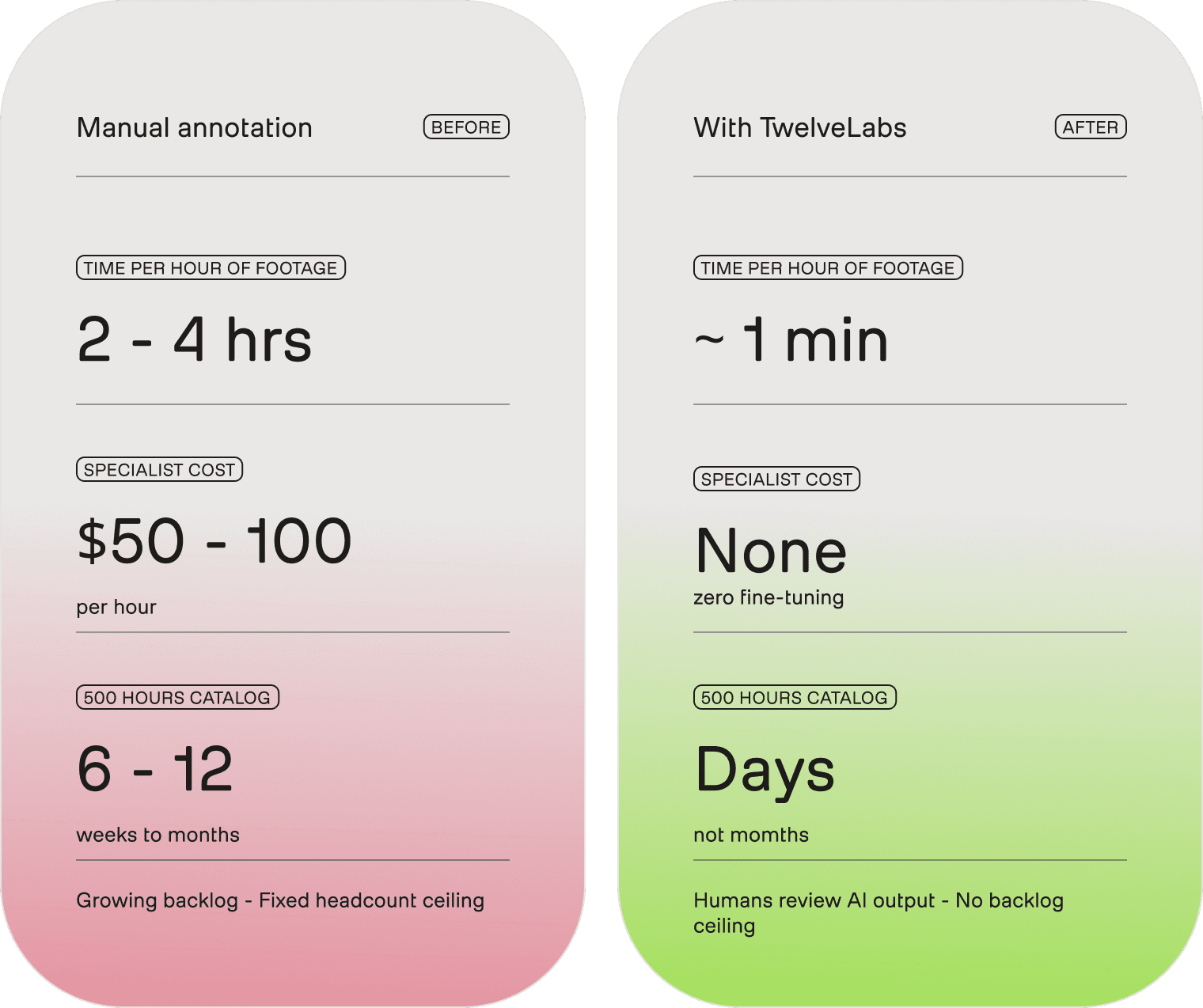
Why manual video annotation breaks at scale
Manual labeling isn't just slow. It compounds. Three dynamics turn a manageable backlog into a structural problem.
Backlogs grow faster than teams can clear them
New footage arrives daily. Manual review capacity is fixed. For every hour of footage that gets labeled, more arrives. The gap between what you capture and what you can use for training only widens, and no amount of hiring closes it, because specialist annotators are expensive and slow to onboard.
Specialist bottlenecks kill project timelines
Domain-specific annotation requires domain expertise. Radiologists for surgical footage. Safety auditors for facility video. Sports analysts for broadcast archives. These people cost more than general annotators, they have full-time jobs that aren't reviewing footage, and routing work through them creates single points of failure. One specialist out sick delays the entire project.
Historical footage stays locked: permanently
Most organizations have years of footage sitting in storage: dashcam recordings, security feeds, archival broadcasts, surgical recordings. The training signal is there. The problem is that labeling it manually doesn't pencil out. At $50–100/hr, a five-year archive isn't a resource: it's a liability. AI annotation is what makes that footage worth processing.
Key takeaway
When AI handles the first pass: finding relevant moments, classifying scenes, generating structured labels: humans move from doing the annotation to reviewing it. The same team processes orders of magnitude more footage.
Four verticals where this problem is most acute
The bottleneck shows up wherever domain-specific video footage is the primary training signal. Four areas stand out.
Retail and loss prevention
Store camera footage contains thousands of hours of shoplifting events, customer flow patterns, and shelf interaction data. The challenge: relevant events are rare, buried in hours of nothing happening. Manual annotation means reviewers watch hours of footage to find seconds of signal. AI finds those moments in minutes and exports labels: shoplifting, customer_dwell, shelf_interaction: ready for shrink prevention model training.
Warehouse and worker safety
Forklift camera and facility feeds need to be annotated with safety violations, PPE compliance events, and restricted zone breaches. These aren't subtle, but finding them in hundreds of hours of facility footage manually is still slow and error-prone. An AI pipeline that can flag forklift_violation and ppe_missing events consistently across every camera, every shift, every day, is the difference between a training dataset and a pile of tapes.
Sports and broadcast
Game film and broadcast archives labeled with player actions, tactical formations, and key moments, for performance analytics, automated highlights, and coaching tools. The volume is extreme (a single season of professional sport generates thousands of hours), the taxonomy is specific (goal_sequence, tactical_press), and the domain expertise required to label it consistently is expensive. AI annotation handles the first pass; analysts handle edge cases.
Medical and surgical
Surgical procedure recordings annotated with instrument usage, procedural phases, and critical events are training data for surgical AI. Expert radiologist review at specialist rates makes the economics brutal for any organization not operating at hyperscale. AI annotation at a fraction of the cost: with human QA on low-confidence labels: is what makes surgical AI datasets viable outside of the largest research institutions.
Note
No fine-tuning required for any of these verticals. You define the label taxonomy for your domain and the model applies it zero-shot. The same pipeline works from retail to surgical to sports: out of the box.
The old workflow vs. the new one
The manual annotation pipeline hasn't meaningfully changed in a decade. Here's what it looks like step by step, and what an AI-first pipeline replaces it with.
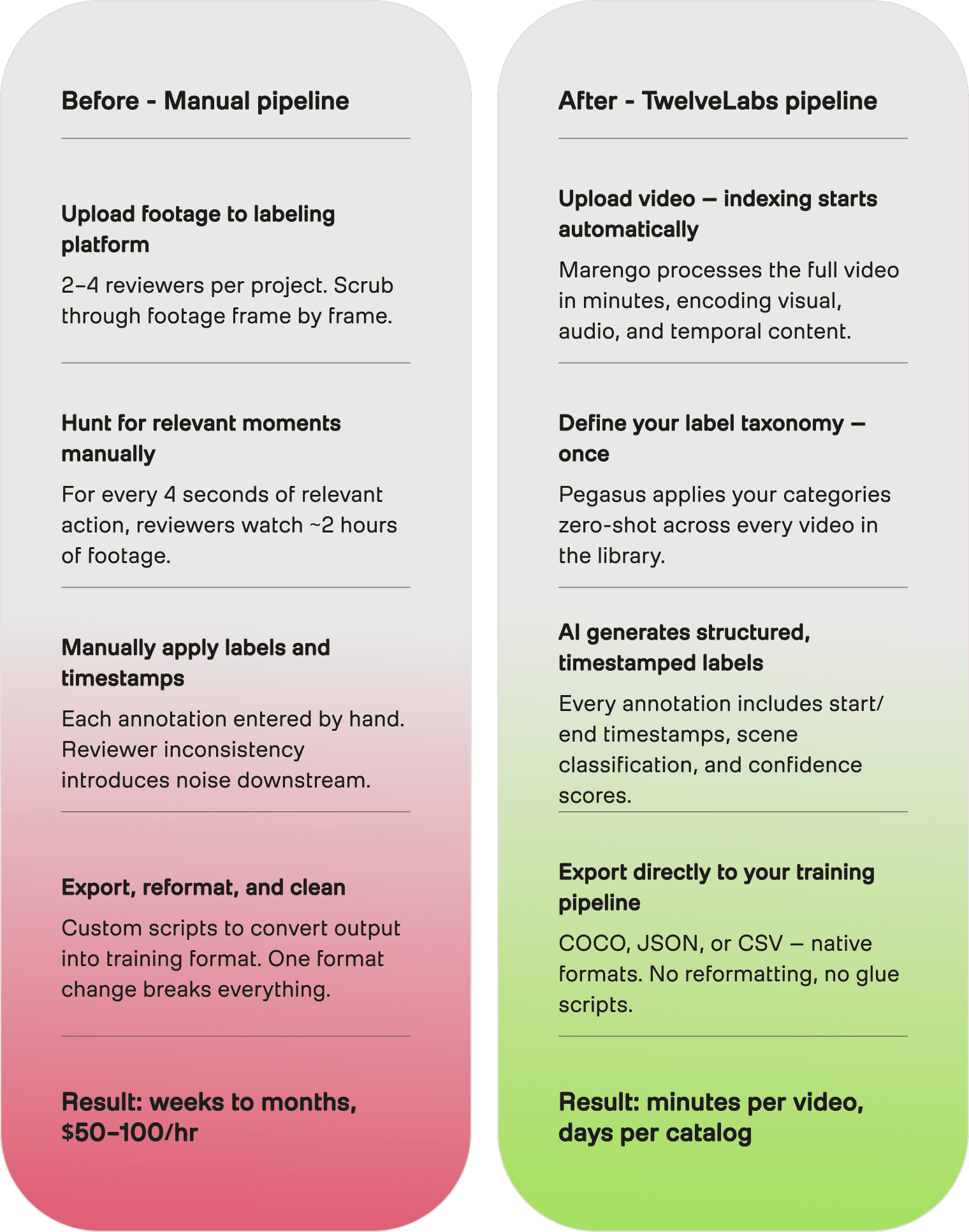
The structural difference: in the manual pipeline, human time is spent on the first pass, the tedious, low-judgment work of scrubbing footage. In the AI pipeline, human time is spent on the last pass: reviewing, refining, and approving what the model generated. Same people, completely different leverage.
How the pipeline actually works
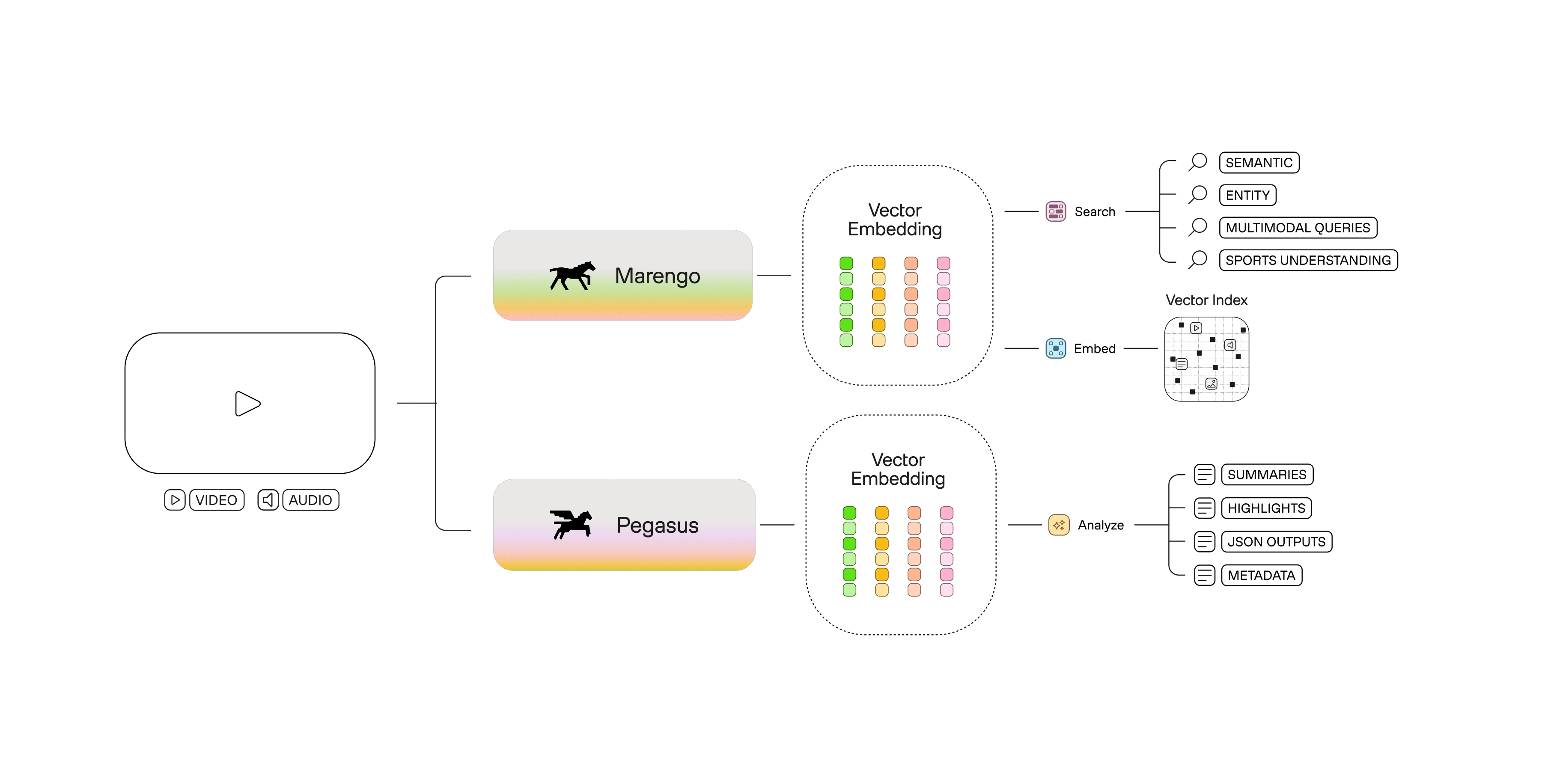
TwelveLabs uses two foundation models in sequence. You don't need to understand the mechanics to use the output, but here's what's happening when your video goes in and training labels come out.
Step 1: Marengo indexes the footage
Marengo watches your video the way a human expert would: processing the visuals, the audio, and the sequence of events together. It encodes all of that into a compact representation that captures what's semantically happening at every moment. The result: a forklift entering a restricted zone at 4:12 is recognized as the same kind of event as one at 38:47, without any rules-based logic.
Step 2: Pegasus generates the labels
Pegasus reasons over Marengo's understanding and produces structured annotations in the exact format your ML pipeline expects. You define the categories: Pegasus applies them to every relevant moment in the video, complete with timestamps and confidence scores. No free-form text to parse. No inconsistency across reviewers.
Step 3: Human QA on flagged items
Low-confidence annotations are automatically routed for human review. Your specialists aren't scrubbing footage anymore: they're reviewing a curated list of edge cases the model flagged. High-confidence annotations go straight to the training dataset.
Step 4: Export to your training pipeline
COCO for PyTorch and Label Studio. JSON for custom data loaders. CSV for pandas-based preprocessing. No reformatting, no custom glue code between annotation and training.
AI labels aren't just faster: they're more consistent
Model quality is a direct function of training data quality. Inconsistent human annotation: different reviewers applying the same label differently: is one of the most common and least-discussed sources of model failure. It introduces noise that's invisible until your model hits production.
Consistency that doesn't drift
Pegasus applies your taxonomy the same way to the first video and the ten-thousandth. No reviewer fatigue. No interpretation drift between annotators. No inconsistency that silently corrupts your training signal six months down the line.
Precision with confidence scores
Every annotation includes exact timestamps and a confidence score. You set the threshold: high-confidence labels go straight to training; lower-confidence ones route to human review. You control the tradeoff between speed and certainty based on what your model actually needs.
Quality that holds at scale
Human annotation quality degrades as volume grows: more reviewers, more inconsistency, more management overhead. AI annotation quality doesn't degrade at scale. Whether you're labeling 10 videos or 10,000, the output is identical. That's not possible with a human-only pipeline.
What the numbers look like
The ROI case for AI-first annotation isn't just cost per label. It's what becomes possible when the bottleneck is removed.
A 500-hour back catalog that once required 6–12 months of annotation labor processes in days, a model in production this quarter instead of next year.
Industry estimates suggest 80–90% reductions in per-project annotation effort on AI-first pipelines, redirecting budget from labor to model development.
Historical footage that was cost-prohibitive to label manually becomes a training asset. Years of dashcam footage, facility feeds, and archival recordings: finally worth processing.
Your specialists stop scrubbing footage and start doing what they're actually hired for: reviewing edge cases, refining taxonomy, and validating model outputs.
Note
The $75K+ and 80–90% figures cited in this post are industry estimates based on typical specialist annotation rates ($50–100/hr) and reported results from organizations using AI-first pipelines. Your numbers will vary based on footage type, taxonomy complexity, and required confidence thresholds.
For engineers: the reference app is open source
A complete Next.js reference application is available on GitHub, a production-grade implementation demonstrating the full pipeline end to end. Clone it, configure your index, and start generating labels against your own footage.
GitHub: github.com/nathanchess/tl-automated-video-data-labeler (MIT licensed, Next.js 16, React 19)
Key APIs:
Marengo Index API: submits video for multimodal indexing, returns 512-dim embeddings per temporal segment across visual, audio, and text modalities.
Pegasus Analyze API: accepts custom label taxonomy + JSON schema, returns schema-enforced annotations with timestamps and confidence scores. Zero fine-tuning.
Export: COCO (native PyTorch DataLoader), JSON (custom data loaders), CSV (pandas preprocessing). Full schema preservation across all formats.
Get started
The annotation bottleneck isn't a people problem. It's a tooling problem. The tools exist. The pipeline is ready.
For ML and data science teams:
Talk to TwelveLabs at twelvelabs.io/contact: get a walkthrough of the annotation pipeline tailored to your footage type, back catalog size, and existing training infrastructure.
For engineers:
Clone the reference app at github.com/nathanchess/tl-automated-video-data-labeler: full pipeline, MIT licensed, deploys with vercel deploy.
Generating computer vision training data from video is eating your ML budget: and most of it happens before a single model trains.
Industry estimates put 60–80% of ML project timelines on data preparation and labeling, not model development. For video, the number feels low. Manual video annotation means hiring specialists at $50–100/hr to scrub footage frame by frame, a 500-hour back catalog can run $75K+ and take 6–12 months before you have a single training-ready dataset. And that's for footage you already own.
AI-first annotation pipelines change that math entirely. This post breaks down exactly how: where the manual process breaks, what a modern pipeline looks like, and what your team can actually do with the time it gets back.
TL;DR: Generating computer vision training data from video manually takes weeks, costs $50–100/hr in specialist time, and leaves most historical footage permanently unlabeled. AI-first annotation pipelines, using video foundation models to index footage and generate structured labels: reduce that timeline from months to days, cut per-project annotation effort by an estimated 80–90%, and export directly to COCO, JSON, or CSV. No fine-tuning required. Your team moves from doing the annotation to reviewing it.
Why manual video annotation breaks at scale
Manual labeling isn't just slow. It compounds. Three dynamics turn a manageable backlog into a structural problem.
Backlogs grow faster than teams can clear them
New footage arrives daily. Manual review capacity is fixed. For every hour of footage that gets labeled, more arrives. The gap between what you capture and what you can use for training only widens, and no amount of hiring closes it, because specialist annotators are expensive and slow to onboard.
Specialist bottlenecks kill project timelines
Domain-specific annotation requires domain expertise. Radiologists for surgical footage. Safety auditors for facility video. Sports analysts for broadcast archives. These people cost more than general annotators, they have full-time jobs that aren't reviewing footage, and routing work through them creates single points of failure. One specialist out sick delays the entire project.
Historical footage stays locked: permanently
Most organizations have years of footage sitting in storage: dashcam recordings, security feeds, archival broadcasts, surgical recordings. The training signal is there. The problem is that labeling it manually doesn't pencil out. At $50–100/hr, a five-year archive isn't a resource: it's a liability. AI annotation is what makes that footage worth processing.
Key takeaway
When AI handles the first pass: finding relevant moments, classifying scenes, generating structured labels: humans move from doing the annotation to reviewing it. The same team processes orders of magnitude more footage.
Four verticals where this problem is most acute
The bottleneck shows up wherever domain-specific video footage is the primary training signal. Four areas stand out.
Retail and loss prevention
Store camera footage contains thousands of hours of shoplifting events, customer flow patterns, and shelf interaction data. The challenge: relevant events are rare, buried in hours of nothing happening. Manual annotation means reviewers watch hours of footage to find seconds of signal. AI finds those moments in minutes and exports labels: shoplifting, customer_dwell, shelf_interaction: ready for shrink prevention model training.
Warehouse and worker safety
Forklift camera and facility feeds need to be annotated with safety violations, PPE compliance events, and restricted zone breaches. These aren't subtle, but finding them in hundreds of hours of facility footage manually is still slow and error-prone. An AI pipeline that can flag forklift_violation and ppe_missing events consistently across every camera, every shift, every day, is the difference between a training dataset and a pile of tapes.
Sports and broadcast
Game film and broadcast archives labeled with player actions, tactical formations, and key moments, for performance analytics, automated highlights, and coaching tools. The volume is extreme (a single season of professional sport generates thousands of hours), the taxonomy is specific (goal_sequence, tactical_press), and the domain expertise required to label it consistently is expensive. AI annotation handles the first pass; analysts handle edge cases.
Medical and surgical
Surgical procedure recordings annotated with instrument usage, procedural phases, and critical events are training data for surgical AI. Expert radiologist review at specialist rates makes the economics brutal for any organization not operating at hyperscale. AI annotation at a fraction of the cost: with human QA on low-confidence labels: is what makes surgical AI datasets viable outside of the largest research institutions.
Note
No fine-tuning required for any of these verticals. You define the label taxonomy for your domain and the model applies it zero-shot. The same pipeline works from retail to surgical to sports: out of the box.
The old workflow vs. the new one
The manual annotation pipeline hasn't meaningfully changed in a decade. Here's what it looks like step by step, and what an AI-first pipeline replaces it with.
The structural difference: in the manual pipeline, human time is spent on the first pass, the tedious, low-judgment work of scrubbing footage. In the AI pipeline, human time is spent on the last pass: reviewing, refining, and approving what the model generated. Same people, completely different leverage.
How the pipeline actually works
TwelveLabs uses two foundation models in sequence. You don't need to understand the mechanics to use the output, but here's what's happening when your video goes in and training labels come out.
Step 1: Marengo indexes the footage
Marengo watches your video the way a human expert would: processing the visuals, the audio, and the sequence of events together. It encodes all of that into a compact representation that captures what's semantically happening at every moment. The result: a forklift entering a restricted zone at 4:12 is recognized as the same kind of event as one at 38:47, without any rules-based logic.
Step 2: Pegasus generates the labels
Pegasus reasons over Marengo's understanding and produces structured annotations in the exact format your ML pipeline expects. You define the categories: Pegasus applies them to every relevant moment in the video, complete with timestamps and confidence scores. No free-form text to parse. No inconsistency across reviewers.
Step 3: Human QA on flagged items
Low-confidence annotations are automatically routed for human review. Your specialists aren't scrubbing footage anymore: they're reviewing a curated list of edge cases the model flagged. High-confidence annotations go straight to the training dataset.
Step 4: Export to your training pipeline
COCO for PyTorch and Label Studio. JSON for custom data loaders. CSV for pandas-based preprocessing. No reformatting, no custom glue code between annotation and training.
AI labels aren't just faster: they're more consistent
Model quality is a direct function of training data quality. Inconsistent human annotation: different reviewers applying the same label differently: is one of the most common and least-discussed sources of model failure. It introduces noise that's invisible until your model hits production.
Consistency that doesn't drift
Pegasus applies your taxonomy the same way to the first video and the ten-thousandth. No reviewer fatigue. No interpretation drift between annotators. No inconsistency that silently corrupts your training signal six months down the line.
Precision with confidence scores
Every annotation includes exact timestamps and a confidence score. You set the threshold: high-confidence labels go straight to training; lower-confidence ones route to human review. You control the tradeoff between speed and certainty based on what your model actually needs.
Quality that holds at scale
Human annotation quality degrades as volume grows: more reviewers, more inconsistency, more management overhead. AI annotation quality doesn't degrade at scale. Whether you're labeling 10 videos or 10,000, the output is identical. That's not possible with a human-only pipeline.
What the numbers look like
The ROI case for AI-first annotation isn't just cost per label. It's what becomes possible when the bottleneck is removed.
A 500-hour back catalog that once required 6–12 months of annotation labor processes in days, a model in production this quarter instead of next year.
Industry estimates suggest 80–90% reductions in per-project annotation effort on AI-first pipelines, redirecting budget from labor to model development.
Historical footage that was cost-prohibitive to label manually becomes a training asset. Years of dashcam footage, facility feeds, and archival recordings: finally worth processing.
Your specialists stop scrubbing footage and start doing what they're actually hired for: reviewing edge cases, refining taxonomy, and validating model outputs.
Note
The $75K+ and 80–90% figures cited in this post are industry estimates based on typical specialist annotation rates ($50–100/hr) and reported results from organizations using AI-first pipelines. Your numbers will vary based on footage type, taxonomy complexity, and required confidence thresholds.
For engineers: the reference app is open source
A complete Next.js reference application is available on GitHub, a production-grade implementation demonstrating the full pipeline end to end. Clone it, configure your index, and start generating labels against your own footage.
GitHub: github.com/nathanchess/tl-automated-video-data-labeler (MIT licensed, Next.js 16, React 19)
Key APIs:
Marengo Index API: submits video for multimodal indexing, returns 512-dim embeddings per temporal segment across visual, audio, and text modalities.
Pegasus Analyze API: accepts custom label taxonomy + JSON schema, returns schema-enforced annotations with timestamps and confidence scores. Zero fine-tuning.
Export: COCO (native PyTorch DataLoader), JSON (custom data loaders), CSV (pandas preprocessing). Full schema preservation across all formats.
Get started
The annotation bottleneck isn't a people problem. It's a tooling problem. The tools exist. The pipeline is ready.
For ML and data science teams:
Talk to TwelveLabs at twelvelabs.io/contact: get a walkthrough of the annotation pipeline tailored to your footage type, back catalog size, and existing training infrastructure.
For engineers:
Clone the reference app at github.com/nathanchess/tl-automated-video-data-labeler: full pipeline, MIT licensed, deploys with vercel deploy.