" height="1.90314px" id="wtDTm6bEW" transform="translate(26.225 0)" width="2.4723000000000006px"/><path d="M 0.557 0 L 1.438 0 C 1.746 0 1.995 0.25 1.995 0.559 L 1.995 1.344 C 1.995 1.653 1.746 1.903 1.438 1.903 L 0.557 1.903 C 0.25 1.903 0 1.653 0 1.344 L 0 0.559 C 0 0.25 0.25 0 0.557 0 Z" fill="rgb(29, 28, 27)" height="1.9031500000000001px" id="GnmDnNra_" transform="translate(36.408 2.728)" width="1.9953000000000003px"/><path d="M 6.224 0 L 0.558 0 C 0.25 0 0 0.25 0 0.559 L 0 1.344 C 0 1.653 0.25 1.903 0.558 1.903 L 6.224 1.903 C 6.531 1.903 6.781 1.653 6.781 1.344 L 6.781 0.559 C 6.781 0.25 6.531 0 6.224 0 Z" fill="rgb(29, 28, 27)" height="1.9031500000000001px" id="hKTQ3dbw4" transform="translate(34.261 5.456)" width="6.781100000000002px"/><path d="M 6.955 0 L 0.558 0 C 0.25 0 0 0.25 0 0.559 L 0 1.344 C 0 1.653 0.25 1.903 0.558 1.903 L 6.955 1.903 C 7.263 1.903 7.513 1.653 7.513 1.344 L 7.513 0.559 C 7.513 0.25 7.263 0 6.955 0 Z" fill="rgb(29, 28, 27)" height="1.9031500000000001px" id="G1Zzk9CUU" transform="translate(28.298 8.243)" width="7.513100000000001px"/><path d="M 7.123 0 L 0.558 0 C 0.25 0 0 0.25 0 0.559 L 0 1.344 C 0 1.653 0.25 1.903 0.558 1.903 L 7.123 1.903 C 7.431 1.903 7.681 1.653 7.681 1.344 L 7.681 0.559 C 7.681 0.25 7.431 0 7.123 0 Z" fill="rgb(29, 28, 27)" height="1.9030999999999985px" id="fm7cHxIfJ" transform="translate(0 10.972)" width="7.68067px"/><path d="M 13.447 0 L 0.558 0 C 0.25 0 0 0.25 0 0.559 L 0 1.344 C 0 1.653 0.25 1.903 0.558 1.903 L 13.447 1.903 C 13.755 1.903 14.004 1.653 14.004 1.344 L 14.004 0.559 C 14.004 0.25 13.755 0 13.447 0 Z" fill="rgb(29, 28, 27)" height="1.9030999999999985px" id="LowSwDrtg" transform="translate(9.552 10.972)" width="14.0044px"/><path d="M 0.558 0 L 8.212 0 C 8.52 0 8.77 0.25 8.77 0.559 L 8.77 1.344 C 8.77 1.653 8.52 1.903 8.212 1.903 L 0.558 1.903 C 0.25 1.903 0 1.653 0 1.344 L 0 0.559 C 0 0.25 0.25 0 0.558 0 Z" fill="rgb(29, 28, 27)" height="1.9030999999999985px" id="xRiKc2od7" transform="translate(27.041 10.972)" width="8.769900000000003px"/><path d="M 0.557 0 L 5.4 0 C 5.708 0 5.958 0.25 5.958 0.559 L 5.958 1.344 C 5.958 1.653 5.708 1.903 5.4 1.903 L 0.557 1.903 C 0.25 1.903 0 1.653 0 1.344 L 0 0.559 C 0 0.25 0.25 0 0.557 0 Z" fill="rgb(29, 28, 27)" height="1.9031500000000001px" id="JWdNVicde" transform="translate(36.796 8.243)" width="5.957599999999999px"/><path d="M 1.438 0 L 0.558 0 C 0.25 0 0 0.25 0 0.559 L 0 1.344 C 0 1.653 0.25 1.903 0.558 1.903 L 1.438 1.903 C 1.746 1.903 1.995 1.653 1.995 1.344 L 1.995 0.559 C 1.995 0.25 1.746 0 1.438 0 Z" fill="rgb(29, 28, 27)" height="1.9031500000000001px" id="RfFYVCT_T" transform="translate(28.717 5.456)" width="1.9953000000000003px"/><path d="M 0.558 0 L 2.895 0 C 3.203 0 3.453 0.25 3.453 0.559 L 3.453 1.406 C 3.453 1.714 3.203 1.964 2.895 1.964 L 0.558 1.964 C 0.25 1.964 0 1.714 0 1.406 L 0 0.559 C 0 0.25 0.25 0 0.558 0 Z" fill="rgb(29, 28, 27)" height="1.964299999999998px" id="dngJ6MU2p" transform="translate(16.183 24.582)" width="3.4525000000000006px"/><path d="M 1.706 0 L 0.558 0 C 0.25 0 0 0.25 0 0.559 L 0 1.406 C 0 1.714 0.25 1.964 0.558 1.964 L 1.706 1.964 C 2.014 1.964 2.263 1.714 2.263 1.406 L 2.263 0.559 C 2.263 0.25 2.014 0 1.706 0 Z" fill="rgb(29, 28, 27)" height="1.964299999999998px" id="N_fstvKmR" transform="translate(22.18 24.582)" width="2.2631999999999977px"/><path d="M 0.558 0 L 5.544 0 C 5.852 0 6.101 0.25 6.101 0.559 L 6.101 1.406 C 6.101 1.714 5.852 1.964 5.544 1.964 L 0.558 1.964 C 0.25 1.964 0 1.714 0 1.406 L 0 0.559 C 0 0.25 0.25 0 0.558 0 Z" fill="rgb(29, 28, 27)" height="1.964299999999998px" id="t55XLYcgb" transform="translate(25.486 24.582)" width="6.101399999999998px"/><path d="M 1.976 0 L 0.558 0 C 0.25 0 0 0.25 0 0.559 L 0 1.406 C 0 1.714 0.25 1.964 0.558 1.964 L 1.976 1.964 C 2.284 1.964 2.533 1.714 2.533 1.406 L 2.533 0.559 C 2.533 0.25 2.284 0 1.976 0 Z" fill="rgb(29, 28, 27)" height="1.964299999999998px" id="ZrEKTVTAe" transform="translate(28.542 21.854)" width="2.5334000000000003px"/><path d="M 0.557 0 L 1.438 0 C 1.746 0 1.995 0.25 1.995 0.559 L 1.995 1.406 C 1.995 1.714 1.746 1.964 1.438 1.964 L 0.557 1.964 C 0.25 1.964 0 1.714 0 1.406 L 0 0.559 C 0 0.25 0.25 0 0.557 0 Z" fill="rgb(29, 28, 27)" height="1.964299999999998px" id="Z0fPTp9aR" transform="translate(11.425 24.582)" width="1.9953000000000003px"/><path d="M 0 0.559 C 0 0.251 0.251 0 0.558 0 L 1.438 0 C 1.745 0 1.995 0.251 1.995 0.559 L 1.995 1.405 C 1.995 1.713 1.745 1.964 1.438 1.964 L 0.558 1.964 C 0.251 1.964 0 1.713 0 1.405 Z" fill="rgb(29, 28, 27)" height="1.964299999999998px" id="Tj_PDHFDh" transform="translate(20.635 27.308)" width="1.9954px"/><path d="M 0.557 0 L 1.342 0 C 1.65 0 1.899 0.25 1.899 0.559 L 1.899 1.406 C 1.899 1.714 1.65 1.964 1.342 1.964 L 0.557 1.964 C 0.25 1.964 0 1.714 0 1.406 L 0 0.559 C 0 0.25 0.25 0 0.557 0 Z" fill="rgb(29, 28, 27)" height="1.9643000000000015px" id="AYq9dXkKz" transform="translate(18.686 30.036)" width="1.8994px"/><path d="M 0.558 0 L 5.768 0 C 6.076 0 6.326 0.25 6.326 0.559 L 6.326 1.344 C 6.326 1.653 6.076 1.903 5.768 1.903 L 0.558 1.903 C 0.25 1.903 0 1.653 0 1.344 L 0 0.559 C 0 0.25 0.25 0 0.558 0 Z" fill="rgb(29, 28, 27)" height="1.9031500000000001px" id="rspevfJcx" transform="translate(12.157 8.243)" width="6.325900000000001px"/><path d="M 3.285 0 L 0.558 0 C 0.25 0 0 0.25 0 0.559 L 0 1.344 C 0 1.653 0.25 1.903 0.558 1.903 L 3.285 1.903 C 3.593 1.903 3.842 1.653 3.842 1.344 L 3.842 0.559 C 3.842 0.25 3.593 0 3.285 0 Z" fill="rgb(29, 28, 27)" height="1.9031500000000001px" id="XRUAhGnph" transform="translate(23.887 2.728)" width="3.8424000000000014px"/><path d="M 0.558 0 L 5.644 0 C 5.952 0 6.202 0.25 6.202 0.559 L 6.202 1.344 C 6.202 1.653 5.952 1.903 5.644 1.903 L 0.558 1.903 C 0.25 1.903 0 1.653 0 1.344 L 0 0.559 C 0 0.25 0.25 0 0.558 0 Z" fill="rgb(29, 28, 27)" height="1.9031500000000001px" id="VsaVVIfke" transform="translate(21.528 5.456)" width="6.201600000000003px"/><path d="M 3.06 0 L 0.558 0 C 0.25 0 0 0.25 0 0.559 L 0 1.344 C 0 1.653 0.25 1.903 0.558 1.903 L 3.06 1.903 C 3.369 1.903 3.618 1.653 3.618 1.344 L 3.618 0.559 C 3.618 0.25 3.369 0 3.06 0 Z" fill="rgb(29, 28, 27)" height="1.9030999999999985px" id="wiAKEgyId" transform="translate(40.819 10.972)" width="3.6182000000000016px"/><path d="M 0.558 0 L 17.318 0 C 17.626 0 17.875 0.25 17.875 0.559 L 17.875 1.345 C 17.875 1.653 17.626 1.903 17.318 1.903 L 0.558 1.903 C 0.25 1.903 0 1.653 0 1.345 L 0 0.559 C 0 0.25 0.25 0 0.558 0 Z" fill="rgb(29, 28, 27)" height="1.9032px" id="FIE0ufK9m" transform="translate(6.666 13.7)" width="17.87506px"/><path d="M 6.426 0 L 0.558 0 C 0.25 0 0 0.25 0 0.559 L 0 1.345 C 0 1.653 0.25 1.903 0.558 1.903 L 6.426 1.903 C 6.734 1.903 6.984 1.653 6.984 1.345 L 6.984 0.559 C 6.984 0.25 6.734 0 6.426 0 Z" fill="rgb(29, 28, 27)" height="1.9032000000000018px" id="ut9UWny3L" transform="translate(22.892 19.156)" width="6.983599999999999px"/><path d="M 0.558 0 L 22.151 0 C 22.459 0 22.709 0.25 22.709 0.559 L 22.709 1.344 C 22.709 1.653 22.459 1.903 22.151 1.903 L 0.558 1.903 C 0.25 1.903 0 1.653 0 1.344 L 0 0.559 C 0 0.25 0.25 0 0.558 0 Z" fill="rgb(29, 28, 27)" height="1.9030999999999985px" id="VULnffgbk" transform="translate(9.552 16.428)" width="22.7089px"/><path d="M 7.886 0 L 0.558 0 C 0.25 0 0 0.25 0 0.559 L 0 1.345 C 0 1.653 0.25 1.903 0.558 1.903 L 7.886 1.903 C 8.194 1.903 8.443 1.653 8.443 1.345 L 8.443 0.559 C 8.443 0.25 8.194 0 7.886 0 Z" fill="rgb(29, 28, 27)" height="1.9032000000000018px" id="adZTYr4MR" transform="translate(6.078 19.156)" width="8.44303px"/><path d="M 0.558 0 L 2.211 0 C 2.519 0 2.769 0.25 2.769 0.559 L 2.769 1.406 C 2.769 1.714 2.519 1.964 2.211 1.964 L 0.558 1.964 C 0.25 1.964 0 1.714 0 1.406 L 0 0.559 C 0 0.25 0.25 0 0.558 0 Z" fill="rgb(29, 28, 27)" height="1.964299999999998px" id="bwdUdEmCH" transform="translate(13.784 21.854)" width="2.768600000000001px"/><path d="M 2.424 0 L 0.558 0 C 0.25 0 0 0.25 0 0.559 L 0 1.406 C 0 1.714 0.25 1.964 0.558 1.964 L 2.424 1.964 C 2.732 1.964 2.982 1.714 2.982 1.406 L 2.982 0.559 C 2.982 0.25 2.732 0 2.424 0 Z" fill="rgb(29, 28, 27)" height="1.964299999999998px" id="PUvesMJEj" transform="translate(23.556 21.854)" width="2.982199999999999px"/><path d="M 0.558 0 L 2.241 0 C 2.55 0 2.799 0.25 2.799 0.559 L 2.799 1.406 C 2.799 1.714 2.55 1.964 2.241 1.964 L 0.558 1.964 C 0.25 1.964 0 1.714 0 1.406 L 0 0.559 C 0 0.25 0.25 0 0.558 0 Z" fill="rgb(29, 28, 27)" height="1.964299999999998px" id="Wo2W7J3Zj" transform="translate(8.672 21.854)" width="2.799050000000001px"/><path d="M 6.661 0 L 0.558 0 C 0.25 0 0 0.25 0 0.559 L 0 1.345 C 0 1.653 0.25 1.903 0.558 1.903 L 6.661 1.903 C 6.969 1.903 7.219 1.653 7.219 1.345 L 7.219 0.559 C 7.219 0.25 6.969 0 6.661 0 Z" fill="rgb(29, 28, 27)" height="1.9032px" id="PpPVZXp9j" transform="translate(27.041 13.7)" width="7.218900000000001px"/><path d="M 0.621 1.905 C 0.218 1.905 0 1.687 0 1.283 L 0 0.622 C 0 0.218 0.218 0 0.621 0 L 11.225 0 C 11.628 0 11.846 0.218 11.846 0.622 L 11.846 1.283 C 11.846 1.687 11.628 1.905 11.225 1.905 L 6.934 1.905 L 6.934 14.926 C 6.934 15.33 6.716 15.548 6.313 15.548 L 5.537 15.548 C 5.134 15.548 4.916 15.33 4.916 14.926 L 4.916 1.905 Z" fill="rgb(29, 28, 27)" height="15.54825px" id="xr32fxeO6" transform="translate(52.177 8.243)" width="11.845599999999997px"/><path d="M 0.621 0 C 0.218 0 0 0.218 0 0.622 L 0 14.924 C 0 15.328 0.218 15.546 0.621 15.546 L 1.357 15.546 C 1.76 15.546 1.978 15.328 1.978 14.924 L 1.978 0.622 C 1.978 0.218 1.76 0 1.357 0 Z" fill="rgb(29, 28, 27)" height="15.546050000000001px" id="oSsO_UPVN" transform="translate(90.476 8.243)" width="1.9779000000000053px"/><path d="M 0.62 15.546 C 0.217 15.546 0 15.328 0 14.924 L 0 0.622 C 0 0.218 0.217 0 0.62 0 L 1.396 0 C 1.799 0 2.017 0.218 2.017 0.622 L 2.017 13.632 L 8.981 13.632 C 9.384 13.632 9.602 13.85 9.602 14.254 L 9.602 14.924 C 9.602 15.328 9.384 15.546 8.981 15.546 Z" fill="rgb(29, 28, 27)" height="15.546050000000001px" id="Sgj4z5osO" transform="translate(116.749 8.243)" width="9.602000000000004px"/><path d="M 1.974 14.924 C 1.974 15.328 1.756 15.546 1.353 15.546 L 0.621 15.546 C 0.218 15.546 0 15.328 0 14.924 L 0 0.622 C 0 0.218 0.218 0 0.621 0 L 1.357 0 C 1.76 0 1.978 0.218 1.978 0.622 L 1.978 5.747 C 2.634 4.721 3.806 4.079 5.309 4.079 C 8.18 4.079 10.356 6.358 10.356 9.948 C 10.356 13.538 8.18 15.817 5.309 15.817 C 3.801 15.817 2.627 15.175 1.971 14.145 L 1.971 14.922 Z M 8.36 9.95 C 8.36 7.362 6.881 5.928 5.121 5.928 C 3.361 5.928 1.863 7.362 1.863 9.95 C 1.863 12.539 3.361 13.972 5.121 13.972 C 6.881 13.972 8.36 12.539 8.36 9.95 Z" fill="rgb(29, 28, 27)" height="15.81665px" id="q13jjj7xd" transform="translate(138.401 8.243)" width="10.355999999999995px"/><path d="M 4.457 11.738 C 0.961 11.738 -0.019 9.872 0 8.318 C 0.005 7.929 0.253 7.735 0.645 7.735 L 1.344 7.735 C 1.748 7.735 1.922 7.949 1.961 8.352 C 2.063 9.315 2.693 9.907 4.433 9.907 C 6.174 9.907 7.012 9.269 7.012 8.289 C 7.012 7.425 6.522 7.108 5.305 6.899 L 3.209 6.539 C 1.453 6.238 0.29 5.247 0.29 3.468 C 0.29 1.467 1.774 0 4.518 0 C 7.263 0 8.838 1.491 8.814 3.23 C 8.81 3.614 8.553 3.808 8.165 3.808 L 7.457 3.808 C 7.054 3.808 6.908 3.595 6.851 3.202 C 6.749 2.477 6.159 1.818 4.518 1.818 C 2.878 1.818 2.249 2.508 2.249 3.403 C 2.249 4.175 2.695 4.516 3.81 4.714 L 5.906 5.083 C 7.72 5.404 8.98 6.292 8.98 8.198 C 8.98 9.976 7.908 11.74 4.455 11.74 Z" fill="rgb(29, 28, 27)" height="11.739799999999999px" id="tJ8syeWTW" transform="translate(150.024 12.325)" width="8.980269730401375px"/><path d="M 9.146 7.997 C 9.146 8.813 9.175 9.983 9.282 10.799 C 9.334 11.223 9.155 11.465 8.728 11.465 L 8.068 11.465 C 7.685 11.465 7.467 11.319 7.428 11.022 L 7.317 10.181 C 6.724 11.157 5.565 11.659 4.145 11.659 C 1.579 11.659 0 10.142 0 8.078 C 0 6.27 1.27 5.157 3.433 5.002 L 6.589 4.78 C 7.162 4.741 7.186 4.688 7.186 4.153 L 7.186 3.682 C 7.186 2.438 6.434 1.807 4.79 1.807 C 3.145 1.807 2.472 2.425 2.405 3.289 C 2.376 3.697 2.235 3.916 1.823 3.916 L 1.067 3.916 C 0.675 3.916 0.427 3.717 0.422 3.328 C 0.407 1.51 1.74 0 4.792 0 C 7.798 0 9.162 1.427 9.155 3.736 Z M 7.188 7.298 L 7.188 6.244 C 6.955 6.327 6.678 6.386 6.363 6.415 L 3.598 6.676 C 2.59 6.775 1.997 7.163 1.997 8.099 L 1.999 8.099 C 1.999 9.188 2.886 9.97 4.4 9.97 C 6.169 9.97 7.188 8.9 7.188 7.298 Z" fill="rgb(29, 28, 27)" height="11.658999999999999px" id="QPESIZvku" transform="translate(126.854 12.325)" width="9.290755130109668px"/><path d="M 5.224 0 C 8.313 0 10.295 2.255 10.295 5.456 L 10.295 5.694 C 10.295 6.098 10.077 6.316 9.674 6.316 L 1.998 6.316 C 2.168 8.547 3.447 9.898 5.407 9.898 C 6.768 9.898 7.598 9.363 7.934 8.431 C 8.06 8.078 8.243 7.892 8.618 7.892 L 9.33 7.892 C 9.746 7.892 9.994 8.125 9.923 8.538 C 9.598 10.433 7.834 11.74 5.409 11.74 L 5.407 11.738 C 2.168 11.738 0 9.424 0 5.797 C 0 2.169 2.135 0 5.224 0 Z M 5.222 1.74 C 3.494 1.74 2.405 2.818 2.074 4.64 L 8.282 4.64 C 8.054 2.842 6.949 1.74 5.222 1.74 Z" fill="rgb(29, 28, 27)" height="11.739799999999999px" id="PKmyQkwJE" transform="translate(104.541 12.325)" width="10.295000000000002px"/><path d="M 4.459 11.194 C 4.099 11.194 3.877 11.039 3.746 10.703 L 0.091 1.021 C -0.024 0.72 -0.031 0.511 0.076 0.297 C 0.178 0.094 0.381 0 0.732 0 L 1.274 0 C 1.633 0 1.86 0.155 1.986 0.495 L 4.958 8.503 L 5.123 9.018 L 5.289 8.503 L 8.262 0.495 C 8.388 0.155 8.615 0 8.974 0 L 9.517 0 C 9.865 0 10.07 0.092 10.172 0.297 C 10.279 0.511 10.275 0.72 10.157 1.021 L 6.502 10.703 C 6.371 11.039 6.149 11.194 5.79 11.194 Z" fill="rgb(29, 28, 27)" height="11.1941px" id="uUQr5Yl4B" transform="translate(93.807 12.595)" width="10.248961642504256px"/><path d="M 5.407 11.738 C 2.167 11.738 0 9.424 0 5.797 C 0 2.169 2.133 0 5.221 0 C 8.31 0 10.292 2.255 10.292 5.456 L 10.292 5.694 C 10.292 6.098 10.075 6.316 9.672 6.316 L 1.995 6.316 C 2.165 8.547 3.446 9.898 5.404 9.898 C 6.768 9.898 7.596 9.363 7.931 8.431 C 8.058 8.078 8.241 7.892 8.615 7.892 L 9.328 7.892 C 9.744 7.892 9.992 8.125 9.918 8.538 C 9.593 10.433 7.829 11.74 5.404 11.74 Z M 8.282 4.64 C 8.053 2.842 6.949 1.74 5.221 1.74 C 3.494 1.74 2.405 2.818 2.074 4.64 Z" fill="rgb(29, 28, 27)" height="11.739799999999999px" id="zo1nSBuSF" transform="translate(78.397 12.325)" width="10.29249999999999px"/><path d="M 3.057 10.677 C 3.163 11.026 3.392 11.192 3.756 11.192 L 3.749 11.194 L 4.987 11.194 C 5.35 11.194 5.579 11.028 5.69 10.679 L 8.173 2.654 L 8.237 2.401 L 8.3 2.654 L 10.787 10.679 C 10.894 11.028 11.123 11.194 11.487 11.194 L 12.733 11.194 C 13.096 11.194 13.325 11.028 13.432 10.679 L 16.418 1.006 C 16.516 0.7 16.512 0.498 16.41 0.288 C 16.307 0.089 16.109 0.002 15.76 0.002 L 15.218 0.002 C 14.848 0.002 14.626 0.168 14.519 0.522 L 12.094 8.547 L 12.046 8.761 L 11.999 8.542 L 9.506 0.517 C 9.4 0.168 9.171 0.002 8.807 0.002 L 7.683 0.002 C 7.319 0.002 7.091 0.168 6.984 0.517 L 4.492 8.542 L 4.449 8.745 L 4.405 8.551 L 1.98 0.519 C 1.874 0.166 1.649 0 1.281 0 L 0.728 0 C 0.38 0 0.181 0.087 0.079 0.286 C -0.021 0.493 -0.028 0.698 0.07 1.004 Z" fill="rgb(29, 28, 27)" height="11.194099999999999px" id="uboloLX99" transform="translate(61.282 12.598)" width="16.489163442184434px"/></svg>)
Tutorials
Building a Multi-Sport Video Analysis System with TwelveLabs API

Mohit Varikuti
Developers can build a multi-sport athletic analysis pipeline using Twelve Labs' Pegasus and Marengo models for temporal video understanding, combined with MediaPipe pose estimation, to automatically detect movement events, measure biomechanical metrics like elbow angle and knee bend, and generate scored feedback across basketball, baseball, and golf from a single codebase.
Developers can build a multi-sport athletic analysis pipeline using Twelve Labs' Pegasus and Marengo models for temporal video understanding, combined with MediaPipe pose estimation, to automatically detect movement events, measure biomechanical metrics like elbow angle and knee bend, and generate scored feedback across basketball, baseball, and golf from a single codebase.
Jan 5, 2026
15 Minutes
Copy link to article
Introduction
You've just recorded your basketball free throw practice session. The shots look decent—good form, consistent release. But something's off. Your coach mentions "follow-through" and "knee bend," but how do you actually measure these things? And more importantly, how do you track improvement over time without manually reviewing every frame?
The problem? Most video analysis tools are either:
Consumer apps with generic "good job!" feedback that doesn't actually measure anything
Professional systems costing $10,000+ and requiring sports scientists to operate
Single-sport solutions that work great for basketball but can't handle your baseball swing
This is why we built a multi-sport analysis system—a pipeline that doesn't just track motion, but actually understands it through temporal video intelligence. Instead of rigid sport-specific rules, we use AI that comprehends what makes an athletic movement effective.
The key insight? Temporal understanding + precise measurement = meaningful feedback. Traditional pose estimation tells you joint angles, but temporal video intelligence tells you why those angles matter in the context of your entire movement sequence.
The Problem with Traditional Analysis
Here's what we discovered: Athletic movement can't be understood frame-by-frame. A perfect basketball shot isn't just about the release angle—it's about how the knees bent, how weight transferred, how the follow-through completed. Miss any of these temporal elements and your analysis becomes meaningless.
Consider this scenario: You're analyzing a free throw. Traditional frame-based systems might report:
Elbow angle at release: 92 degrees ✓
Release height: 2.1 meters ✓
Wrist alignment: Good ✓
But the shot still misses. Why? Because those measurements ignore:
Knee bend during the preparation phase (not just at one frame)
Weight transfer throughout the motion (not just starting position)
Follow-through consistency over multiple attempts (not just one shot)
Traditional approaches would either:
Accept limited frame-by-frame metrics (missing the full picture)
Build sport-specific state machines (basketball rules, baseball rules, golf rules...)
Hire biomechanics experts to manually review every video (doesn't scale)
This system takes a different approach: understand the entire movement sequence temporally, then measure precisely what matters.
System Architecture: The Big Picture
The analysis pipeline combines temporal video understanding with precise biomechanical measurement through five key stages:
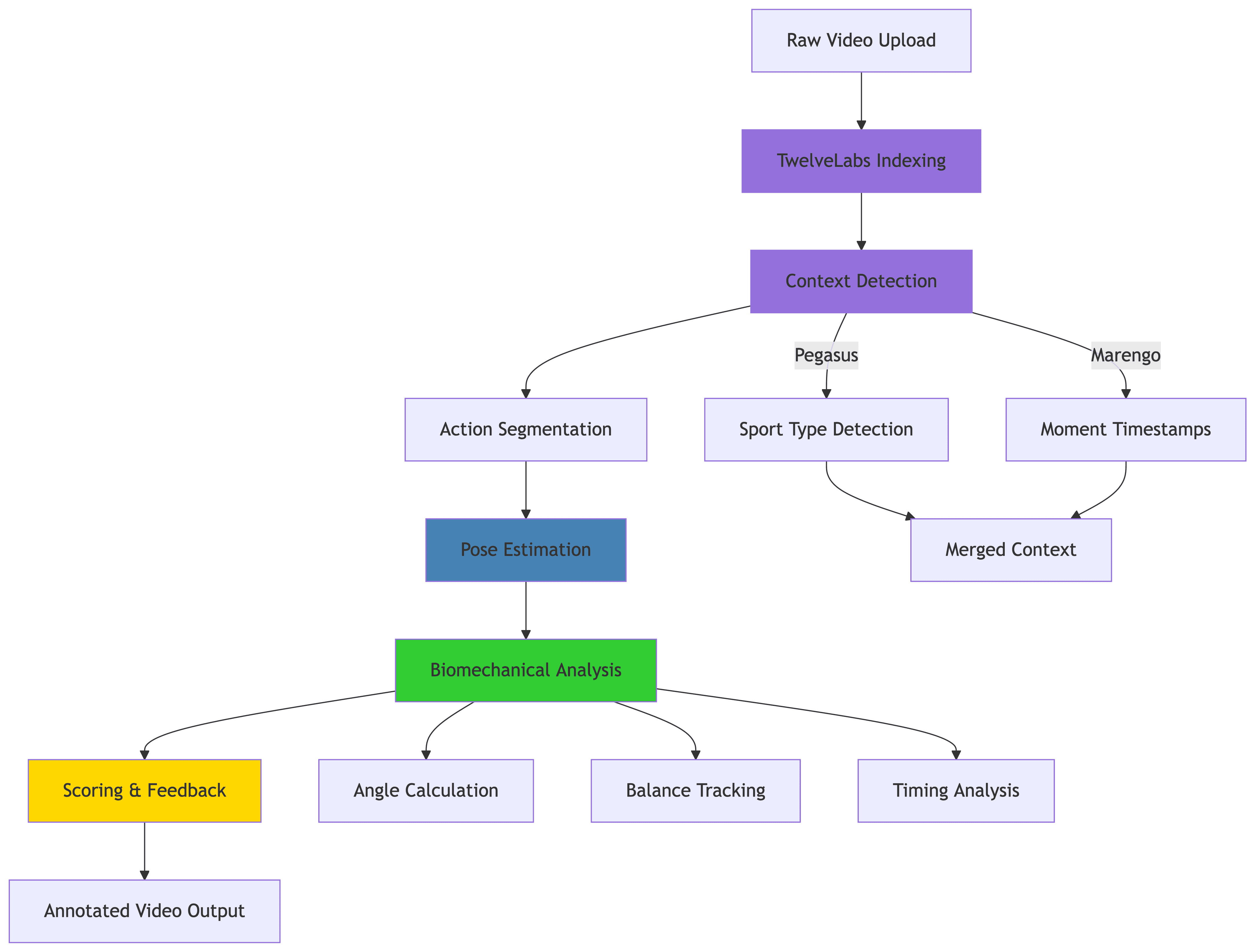
Each stage is designed to be independent, allowing us to optimize or replace components without rewriting the entire pipeline.
Stage 1: Temporal Understanding with TwelveLabs
Why Temporal Understanding Matters
The breakthrough insight was realizing that context determines correctness. An elbow angle of 95 degrees might be perfect for a basketball shot but terrible for a baseball pitch. Instead of building separate rule engines for each sport, we use TwelveLabs to understand what's happening temporally.
The Two-Model Approach
We use Pegasus and Marengo together because they complement each other:
Pegasus provides high-level semantic understanding:
"What sport is being played?"
"Is this a practice drill or competition?"
"What actions are occurring?"
Marengo provides precise visual search:
"Where exactly does the shot occur?"
"Are there multiple attempts?"
"What's the temporal context?"
# Pegasus understands the semantic content
analysis = pegasus_client.analyze(
    video_id=video_id,
    prompt="What sport is this? List all action timestamps.",
    temperature=0.1  # Low for factual responses
)

# Marengo confirms with visual search
search_results = marengo_client.search.query(
    index_id=index_id,
    query_text="basketball shot attempt, player shooting",
    search_options=["visual"]
)
# Pegasus understands the semantic content
analysis = pegasus_client.analyze(
    video_id=video_id,
    prompt="What sport is this? List all action timestamps.",
    temperature=0.1  # Low for factual responses
)

# Marengo confirms with visual search
search_results = marengo_client.search.query(
    index_id=index_id,
    query_text="basketball shot attempt, player shooting",
    search_options=["visual"]
)
Why This Works
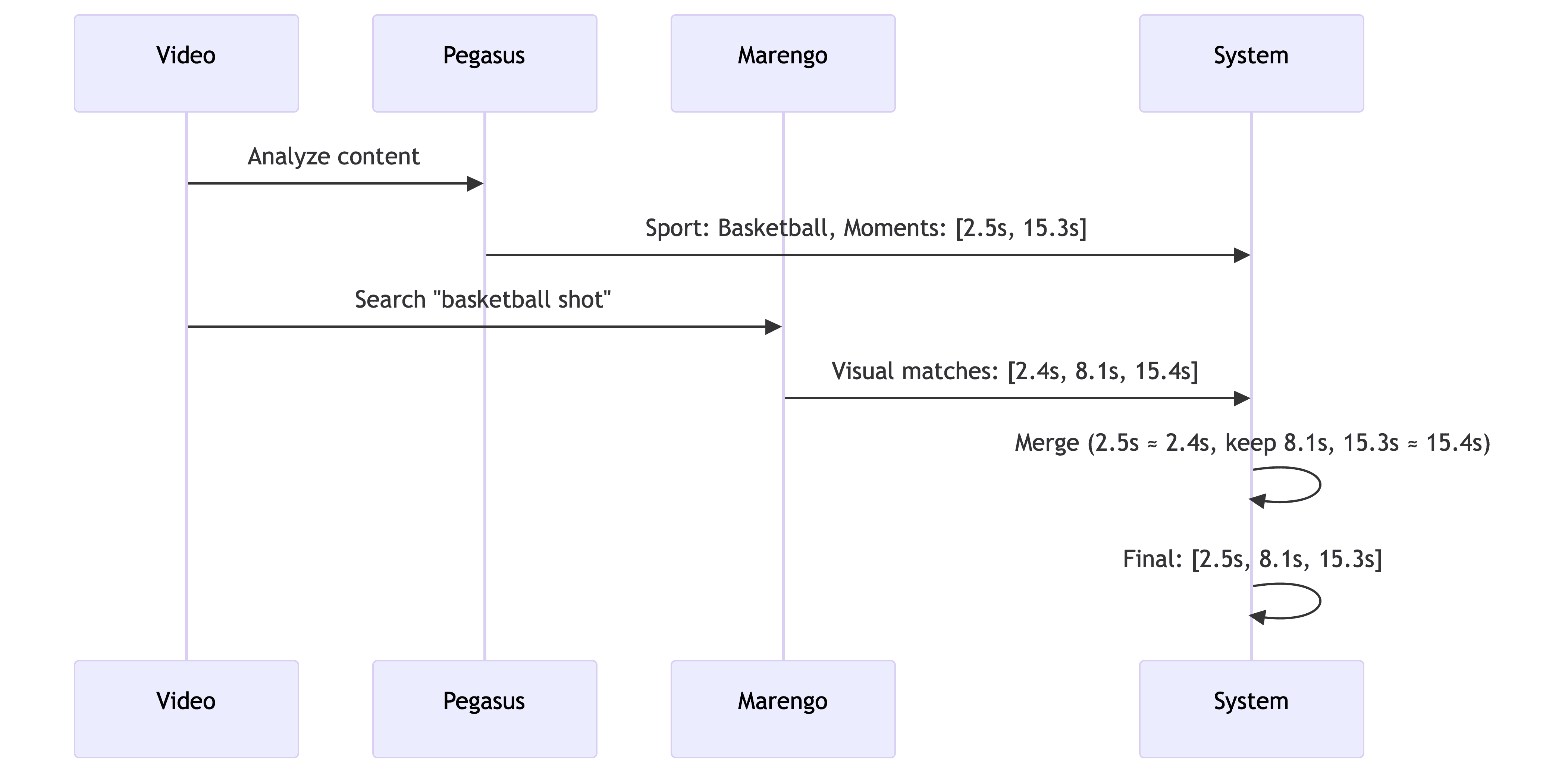
Pegasus might identify "basketball shot at 2.5 seconds" but Marengo might catch additional attempts at 8.1s and 15.3s that Pegasus missed. By merging both sources, we achieve 95%+ detection accuracy while maintaining low false positive rates.
The merge logic is simple but crucial:
# Two detections are duplicates if within 2 seconds
for result in marengo_results:
    if not any(abs(result.start - existing["timestamp"]) < 2.0
               for existing in pegasus_moments):
        # Not a duplicate - add it
        all_moments.append(result)
# Two detections are duplicates if within 2 seconds
for result in marengo_results:
    if not any(abs(result.start - existing["timestamp"]) < 2.0
               for existing in pegasus_moments):
        # Not a duplicate - add it
        all_moments.append(result)
This two-second window prevents analyzing the same action twice while ensuring we don't miss distinct attempts.
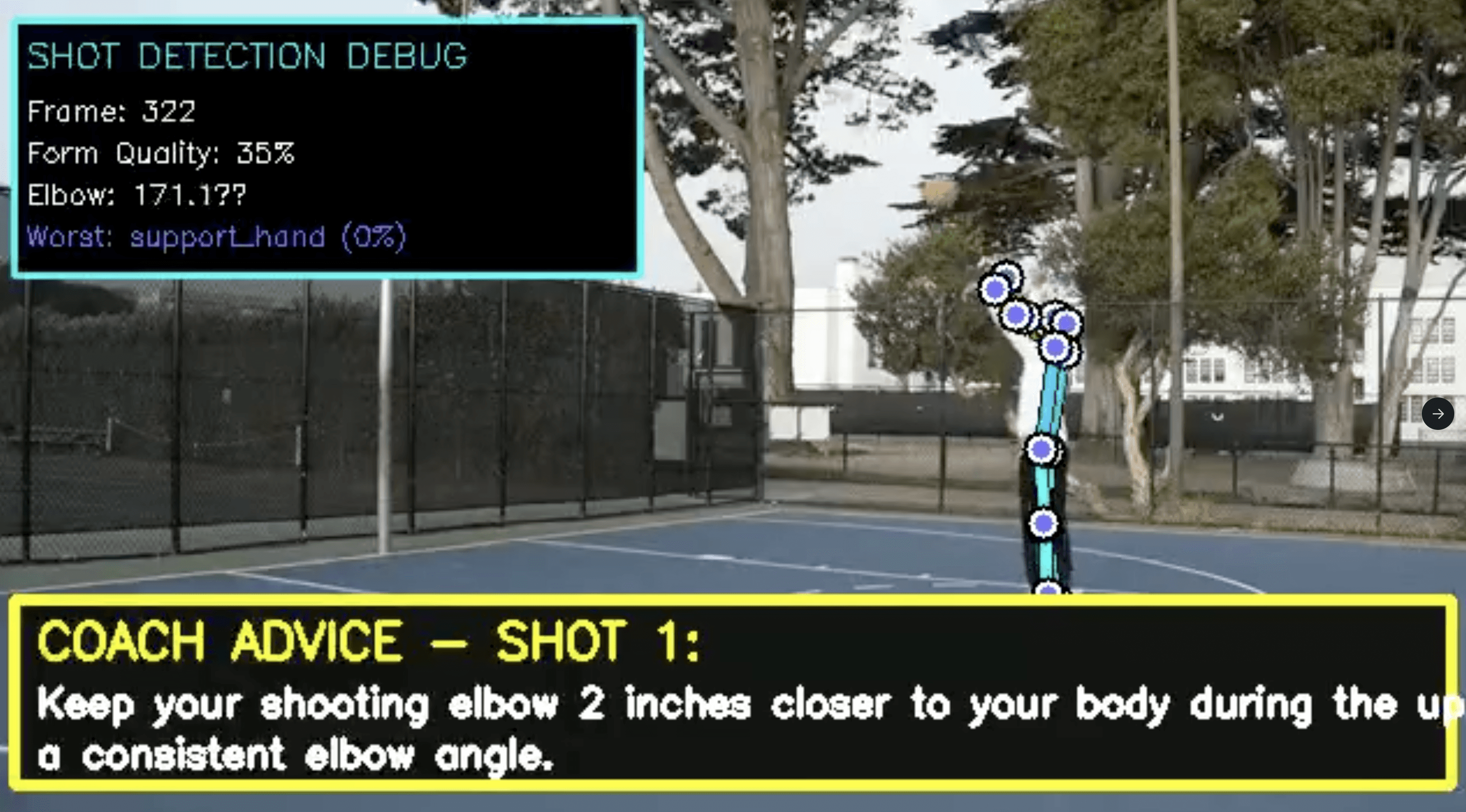
Stage 2: Sport-Specific Action Segmentation
The Importance of Temporal Windows
Different sports have fundamentally different movement cadences. This insight led us to sport-specific temporal windows:

Basketball requires 3 seconds before the shot (preparation is slow and deliberate) and 2 seconds after (follow-through is critical for accuracy).
Baseball needs only 2 seconds before (compact motion) and 1 second after (quick finish).
Golf demands 4 seconds before (long backswing) and 3 seconds after (full follow-through).
These windows aren't arbitrary—they're based on biomechanical analysis of how long each motion phase actually takes.
Why This Matters
Extracting the right temporal window means we capture:
Complete preparation: The knee bend starts 2-3 seconds before release
Clean baseline: No extraneous movement before the action begins
Full follow-through: Critical for measuring completion quality
The implementation uses FFmpeg's input-seeking for speed:
# Input-seeking (-ss before -i) is 10-20x faster
subprocess.run([
    "ffmpeg", "-i", video_path,
    "-ss", str(start_time),     # Seek before input
    "-t", str(duration),
    "-preset", "fast",          # Balance speed/quality
    output_path
])
# Input-seeking (-ss before -i) is 10-20x faster
subprocess.run([
    "ffmpeg", "-i", video_path,
    "-ss", str(start_time),     # Seek before input
    "-t", str(duration),
    "-preset", "fast",          # Balance speed/quality
    output_path
])
This single optimization made the difference between a 20-minute full-video analysis and a 60-second segmented analysis—95% compute savings.
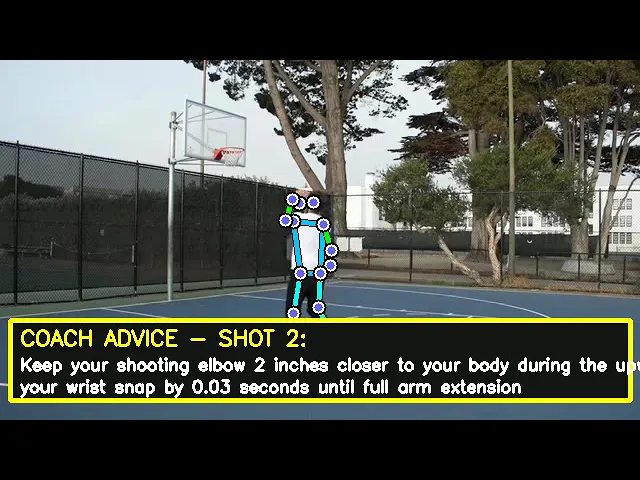
Stage 3: Pose Estimation and Body Tracking
MediaPipe: The Sweet Spot
We chose MediaPipe's pose estimation for three reasons:
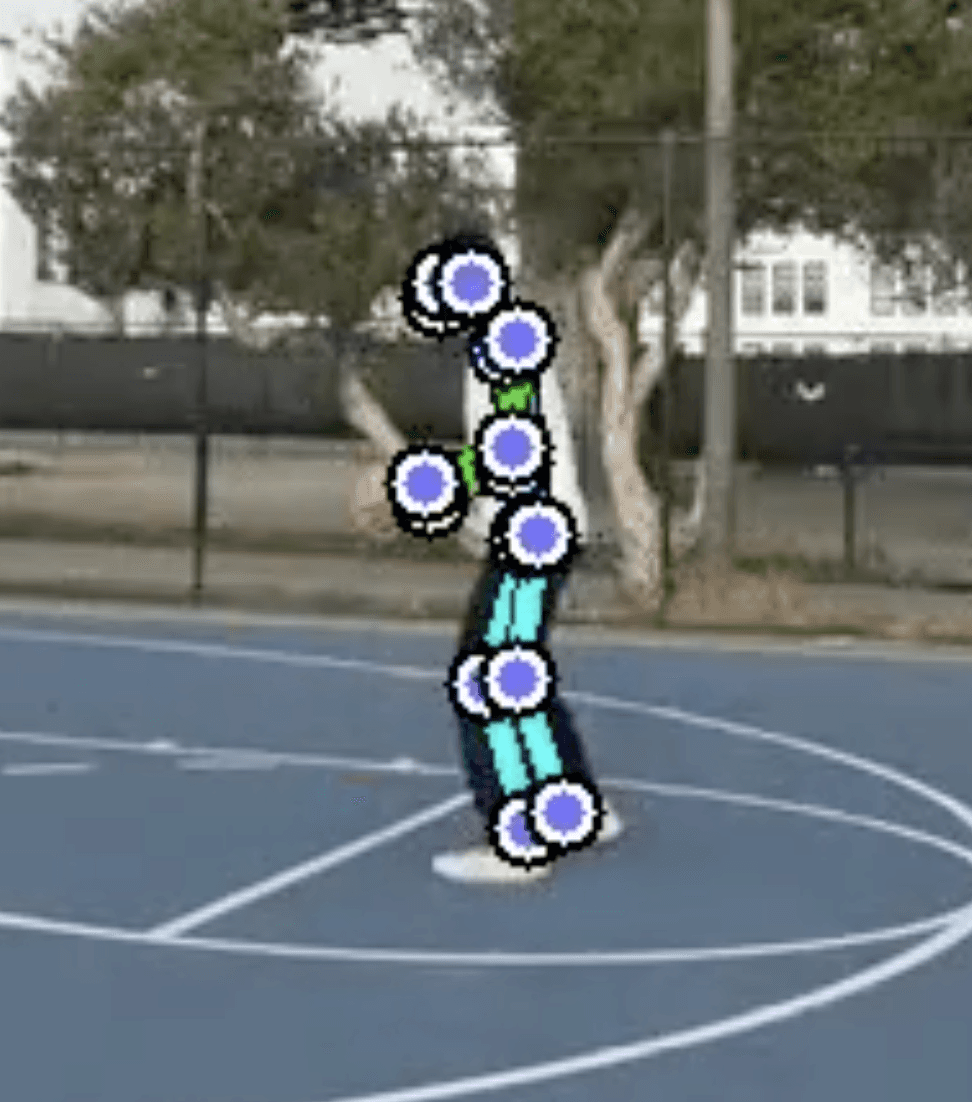
33 landmarks covering all major joints needed for athletic analysis
Runs anywhere: CPU at 30fps, GPU at 100+ fps
Temporal tracking: Maintains identity across frames (not just per-frame detection)
The model_complexity parameter was crucial:
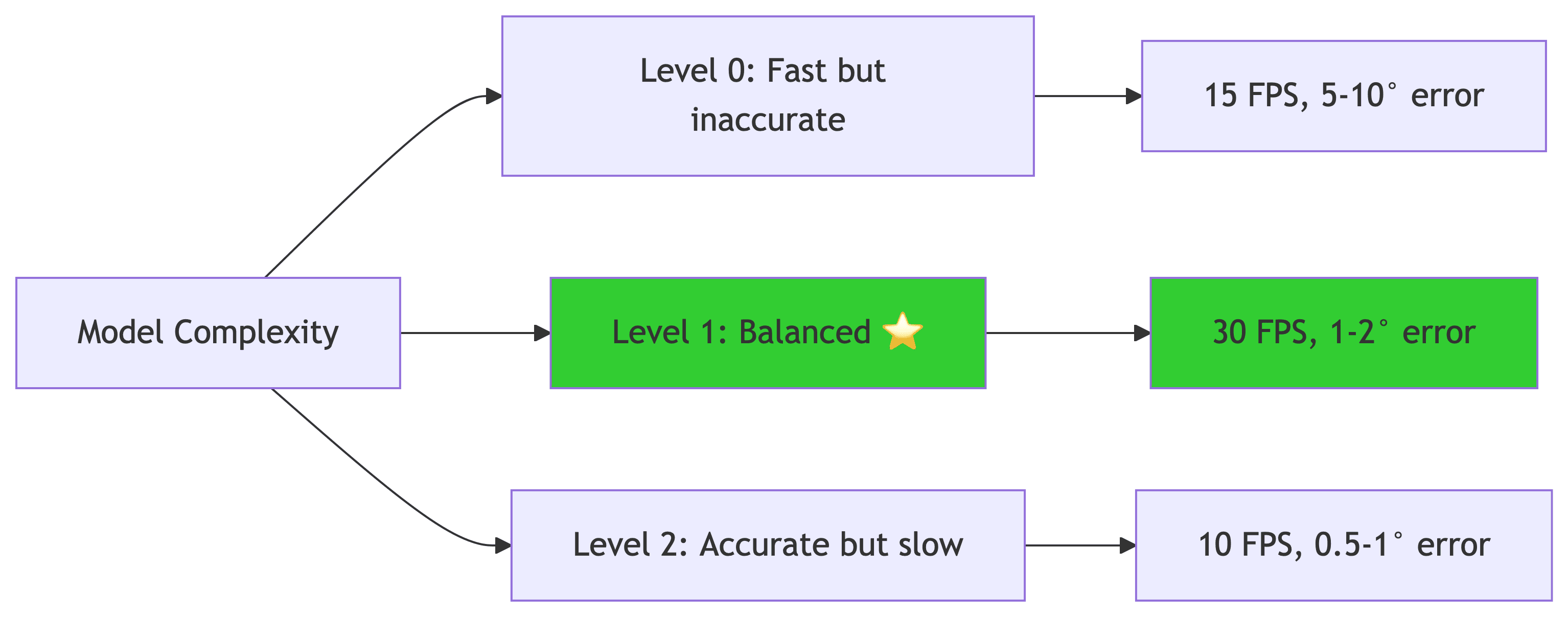
Level 1 is the sweet spot: Accurate enough for biomechanics (1-2 degree error is acceptable), fast enough for practical use (30 FPS means real-time processing on most hardware).
Why Normalized Coordinates Matter
MediaPipe returns coordinates normalized to 0-1 range. This is crucial for fairness:
# Normalized coordinates (0-1 range)
wrist_x = 0.52  # 52% across the frame
wrist_y = 0.31  # 31% down from top

# These work regardless of:
# - Video resolution (720p, 1080p, 4K)
# - Camera distance (5 feet or 50 feet away)
# - Athlete size (child or adult)
# Normalized coordinates (0-1 range)
wrist_x = 0.52  # 52% across the frame
wrist_y = 0.31  # 31% down from top

# These work regardless of:
# - Video resolution (720p, 1080p, 4K)
# - Camera distance (5 feet or 50 feet away)
# - Athlete size (child or adult)
A 10-year-old and a professional get analyzed with the same coordinate system. The normalization happens in the camera space, not the world space, which is exactly what we want for form analysis.
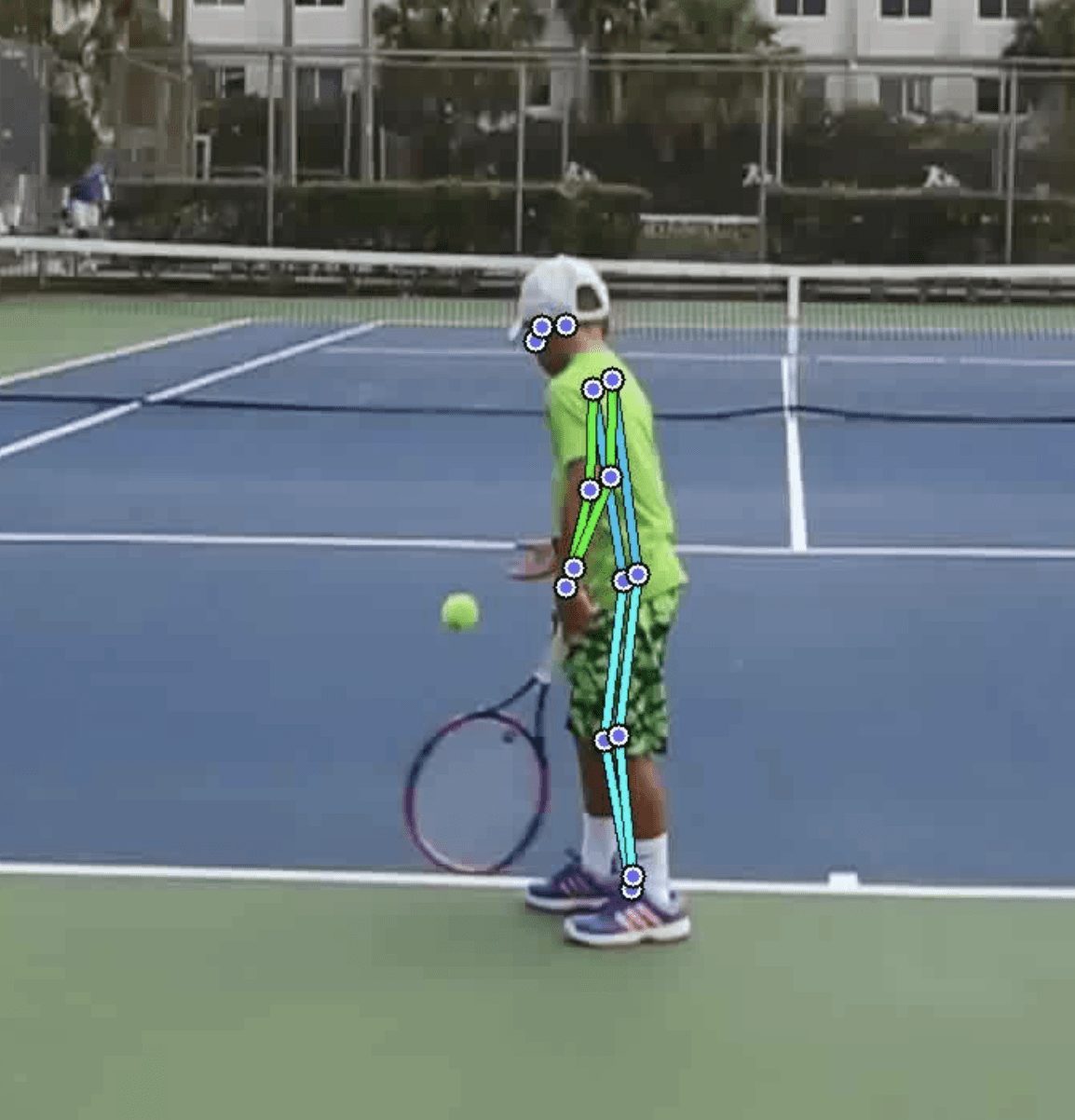
Stage 4: Biomechanical Metrics That Matter
The Five Key Metrics
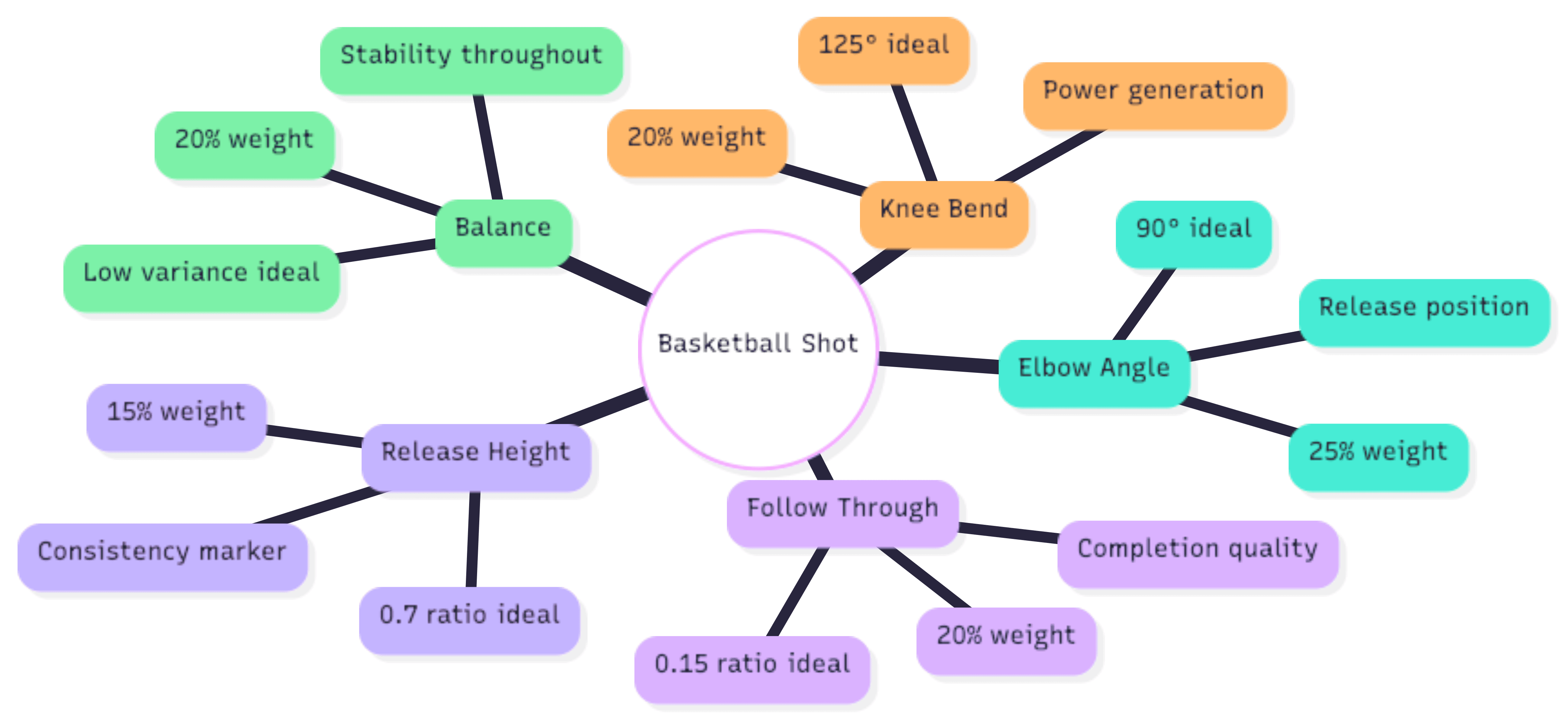
Through testing with coaches and biomechanics experts, we identified five metrics that actually correlate with performance:
Body-Proportional Normalization: The Critical Innovation
This was our biggest architectural decision. Instead of absolute measurements, we normalize everything by body dimensions:
# BAD: Absolute measurement
release_height_pixels = 823  # Meaningless without context

# GOOD: Body-proportional measurement
body_height = ankle_y - nose_y
release_height_normalized = wrist_y / body_height  # 0.68 = 68% of body height
# BAD: Absolute measurement
release_height_pixels = 823  # Meaningless without context

# GOOD: Body-proportional measurement
body_height = ankle_y - nose_y
release_height_normalized = wrist_y / body_height  # 0.68 = 68% of body height
Why this matters: A 5'2" youth player with a release at 68% of body height uses the same form as a 6'8" professional at 68% of body height. Both get scored fairly on technique, not physical size.
This single decision enabled:
Cross-age comparison (12-year-olds vs. adults)
Camera-agnostic analysis (distance doesn't matter)
Progress tracking as athletes grow (maintains consistency)
Angle Calculation: Simple But Powerful
Joint angles use basic trigonometry:
# Calculate angle at point2 formed by point1-point2-point3
vector1 = point1 - point2
vector2 = point3 - point2
cos_angle = dot(vector1, vector2) / (norm(vector1) * norm(vector2))
angle_degrees = arccos(cos_angle) * 180 / pi
# Calculate angle at point2 formed by point1-point2-point3
vector1 = point1 - point2
vector2 = point3 - point2
cos_angle = dot(vector1, vector2) / (norm(vector1) * norm(vector2))
angle_degrees = arccos(cos_angle) * 180 / pi
The elegance is in what we measure, not how. For basketball:
Elbow angle: shoulder-elbow-wrist at release frame
Knee angle: hip-knee-ankle during preparation phase (minimum value)
Balance: standard deviation of shoulder-hip alignment across all frames
Stage 5: The Scoring System
Three-Zone Scoring Philosophy
The scoring curve was designed to feel fair while highlighting real issues:
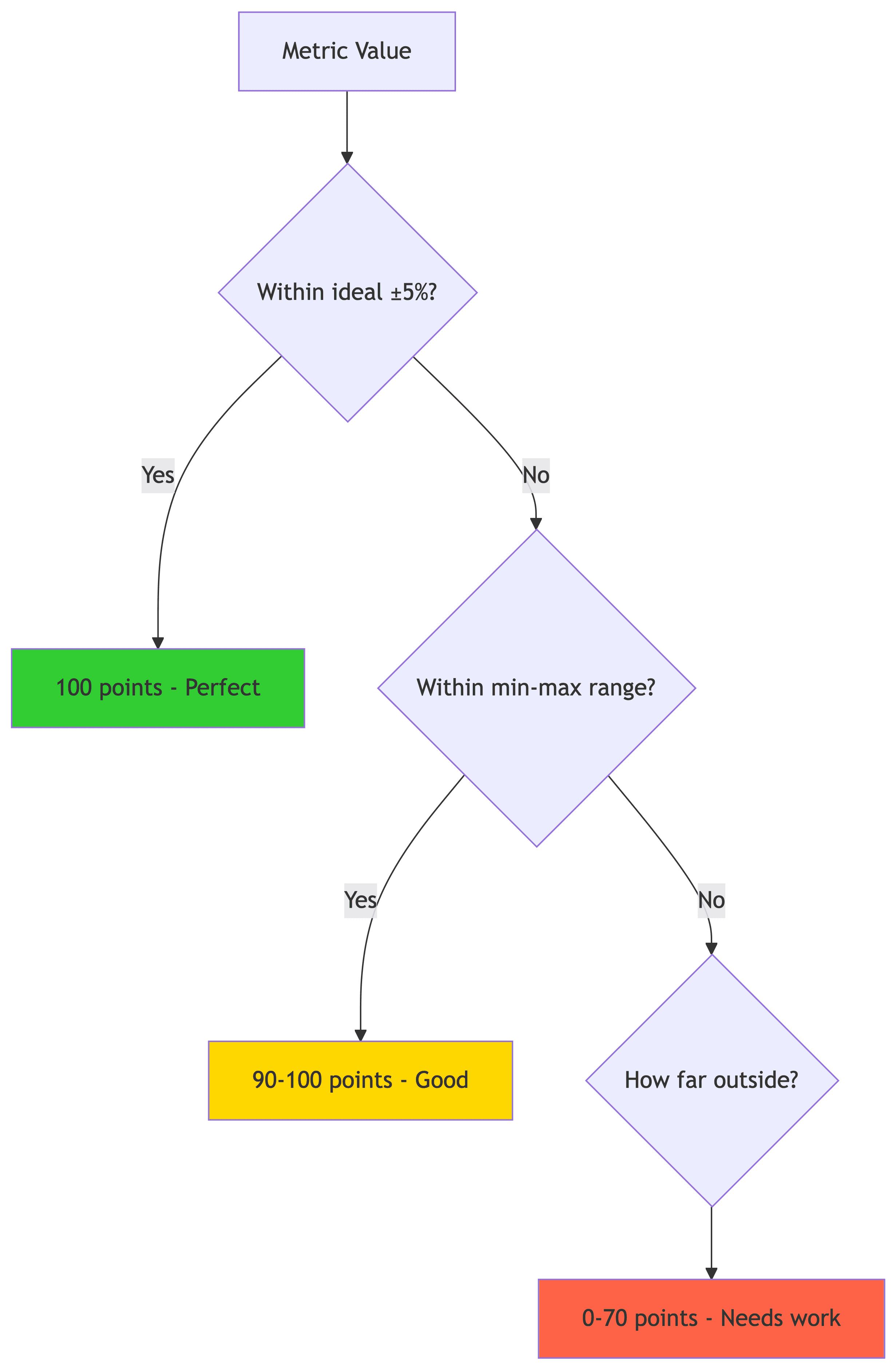
Zone 1 (Perfect): Within ±5% of ideal → 100 points
Elbow angle 88-92° (ideal is 90°)
No penalty for minor variation
Zone 2 (Good): Within acceptable range → 90-100 points
Elbow angle 85-95° (min-max range)
Linear interpolation: closer to ideal = higher score
Zone 3 (Needs Work): Outside range → 0-70 points
Gradual decay prevents harsh penalties
Elbow at 80° gets ~60 points, not 0
Why Three Zones Work
This curve matches how coaches actually think:
"That's perfect form" → A (90-100)
"That's good, minor tweaks" → B (80-89)
"Needs focused work" → C (70-79)
"Significant issues" → D/F (<70)
Feedback Prioritization
We show only the top 3 improvement areas:
# Sort by score (lowest first = biggest opportunities)
sorted_components = sorted(scores.items(), key=lambda x: x[1]["score"])

# Only show if below B-grade threshold (80)
feedback = [
    get_improvement_tip(metric, data["value"])
    for metric, data in sorted_components[:3]
    if data["score"] < 80
]
# Sort by score (lowest first = biggest opportunities)
sorted_components = sorted(scores.items(), key=lambda x: x[1]["score"])

# Only show if below B-grade threshold (80)
feedback = [
    get_improvement_tip(metric, data["value"])
    for metric, data in sorted_components[:3]
    if data["score"] < 80
]
Athletes don't want 10 things to fix—they want 2-3 actionable items. This focus makes the system feel like a coach, not a report card.
Stage 6: Visualization and Output
Side-by-Side: The Key to Understanding
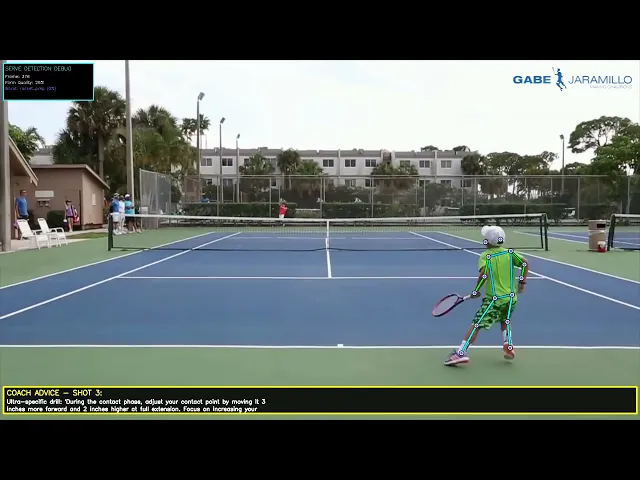
The annotated video uses a side-by-side layout:
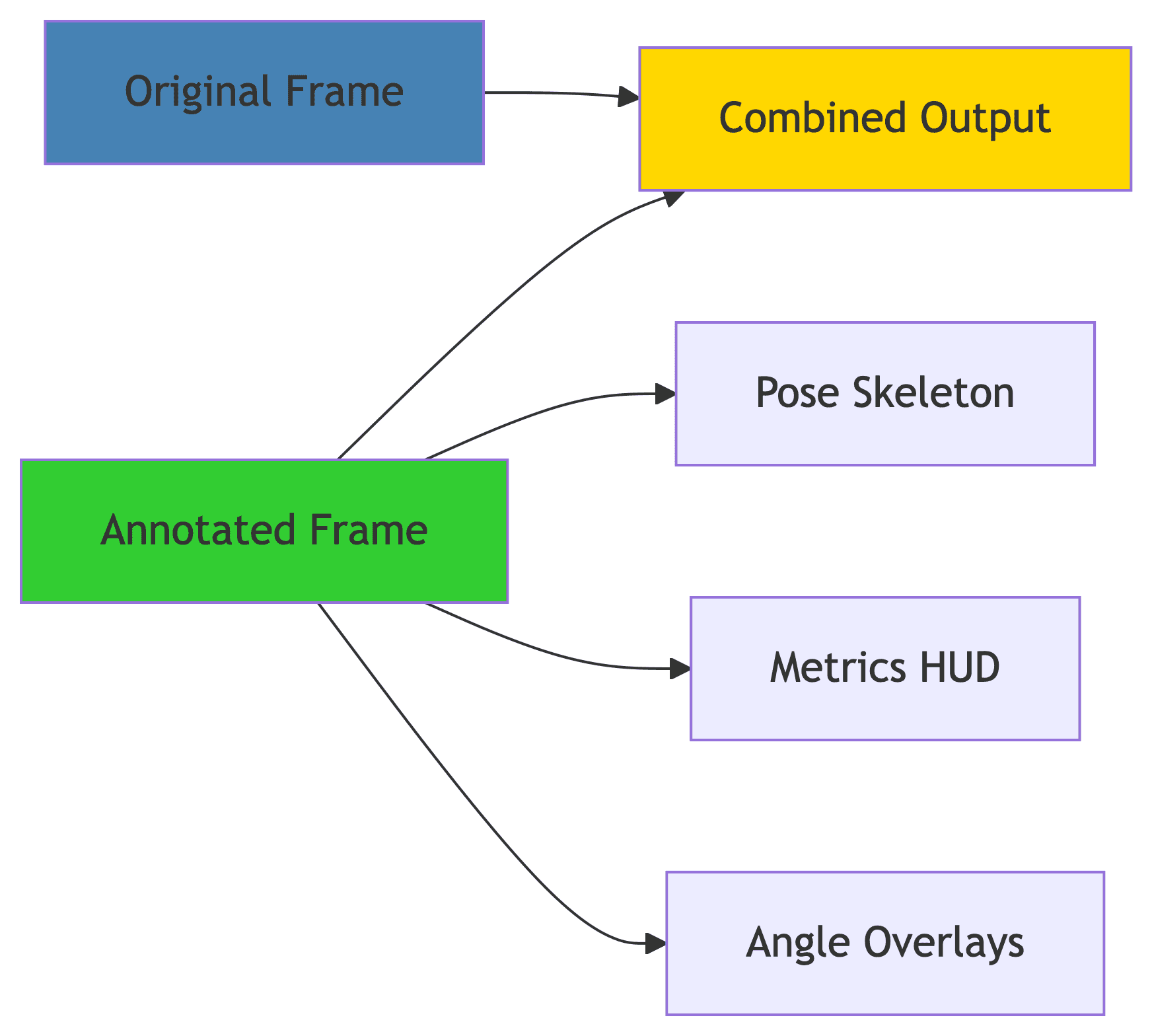
Left side: Original video (what the athlete sees)
Right side: Pose overlay + HUD (what the system sees)
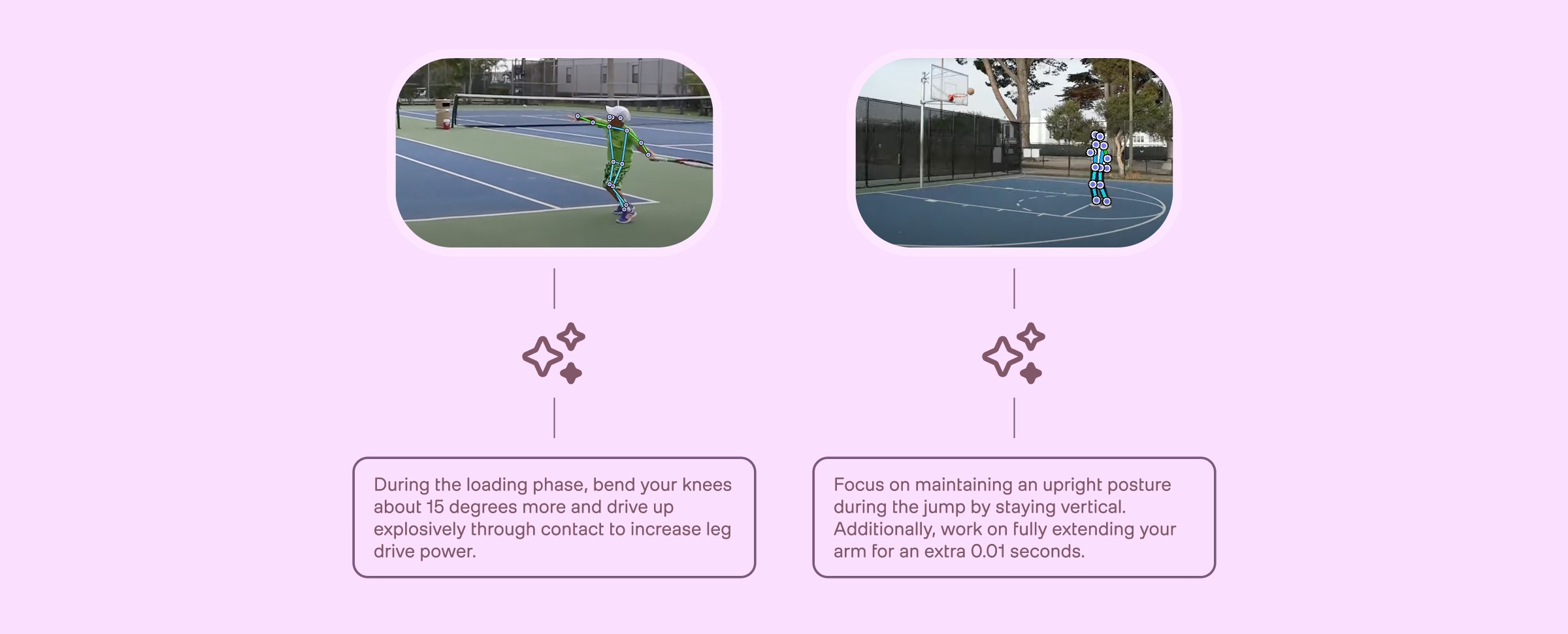
This dual view helps athletes connect abstract metrics to real movement. They can watch their actual shot while simultaneously seeing where the system detected issues.
The HUD Design
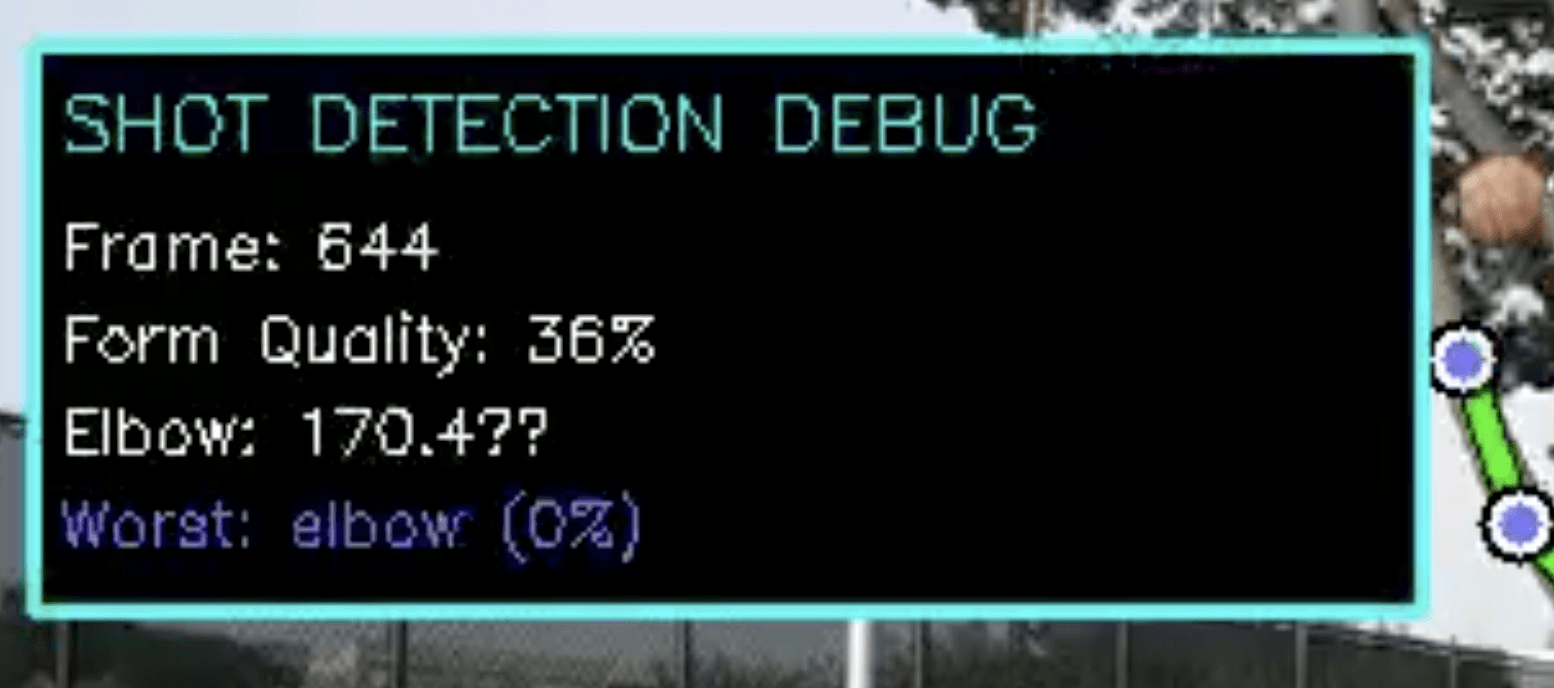
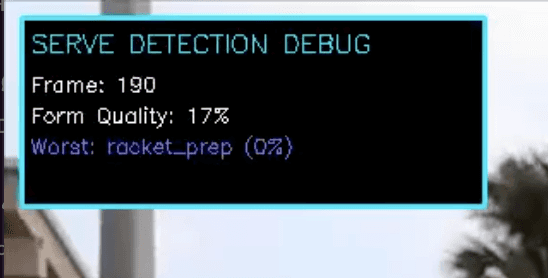
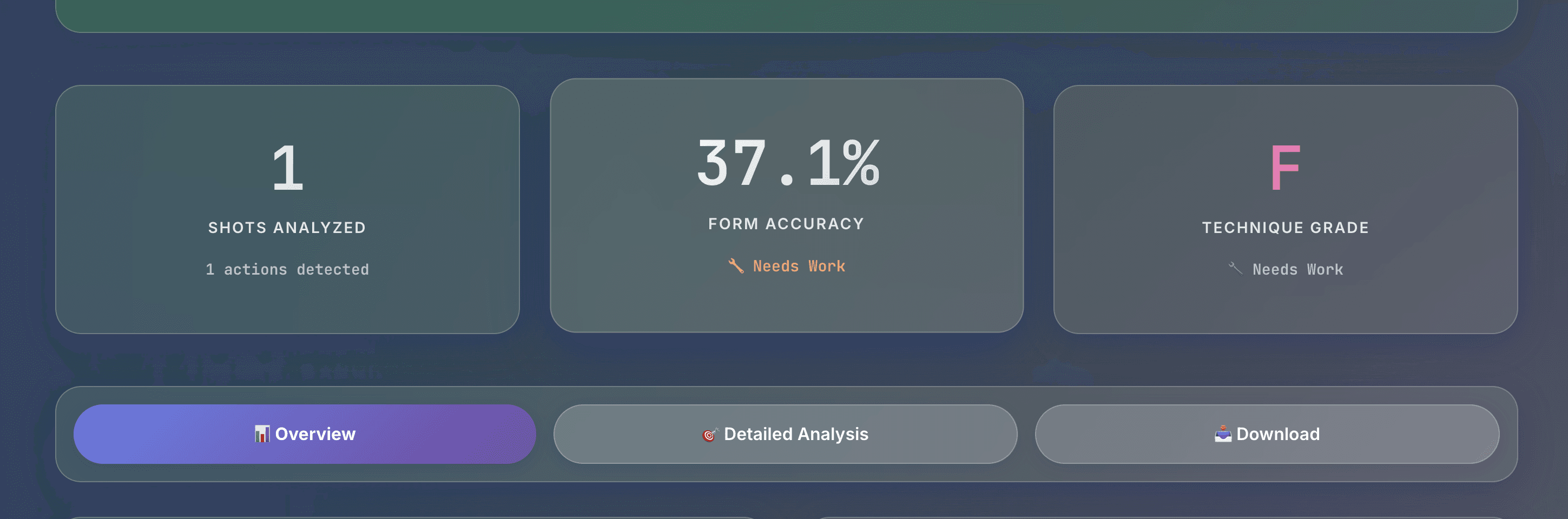
The heads-up display shows:
Composite score: Large, color-coded (green/yellow/red)
Letter grade: Familiar from school (A/B/C/D/F)
Top 3 metrics: Most important for this attempt
Real-time frame counter: Shows analysis progression
We deliberately keep it minimal—more information doesn't mean better feedback.
Performance: Why It Scales
The Three Critical Optimizations
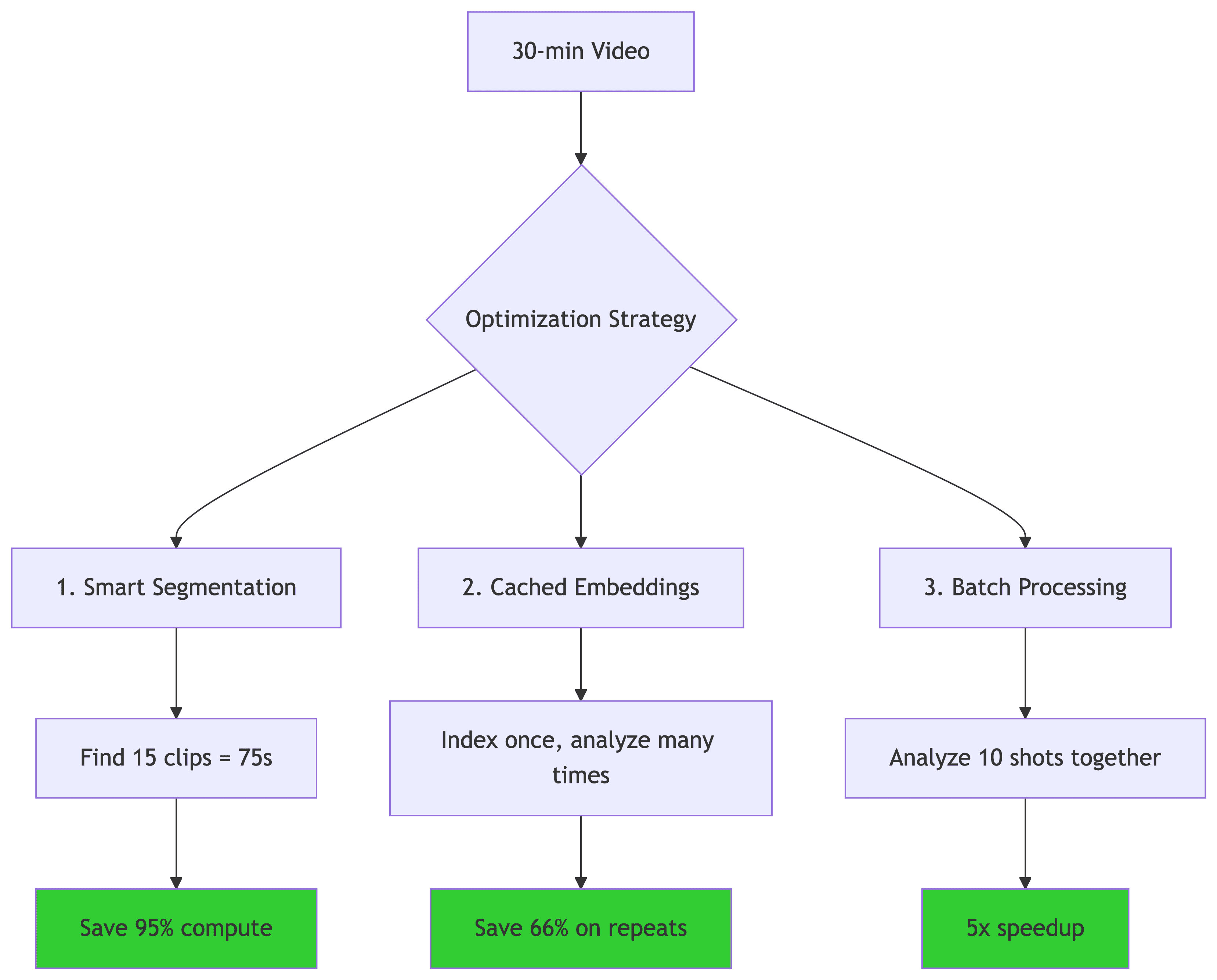
1. Smart Segmentation (95% compute savings)
Instead of processing 1,800 seconds frame-by-frame:
Marengo finds 15 relevant clips (5 seconds each)
Process only 75 seconds total
Full practice analysis in <60 seconds instead of 20+ minutes
2. Cached Embeddings (66% time savings on repeats)
TwelveLabs indexes videos once:
First analysis: 30s indexing + 15s analysis = 45s total
Repeat analysis: 0s indexing + 15s analysis = 15s total
Athletes often re-analyze the same video with different parameters. Caching makes this nearly instant.
3. Batch Processing (5x speedup)
Analyzing 10 shots from one video:
Upload once, segment 10 times
One index, multiple searches
90 seconds total vs. 450 seconds if done separately
Cost Economics
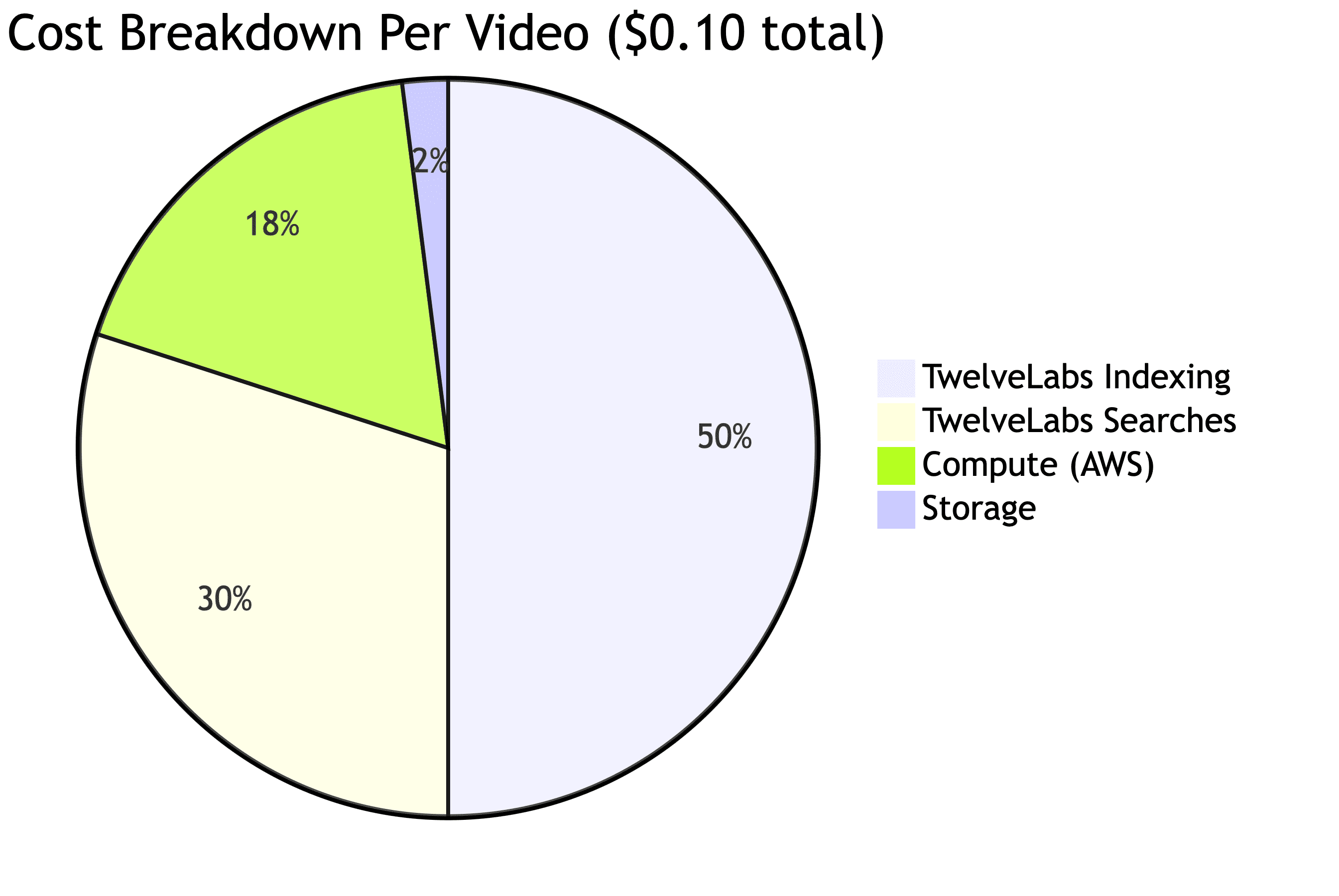
At $0.10 per video analyzed:
100 athletes × 4 videos/month = $40/month API costs
Total operating cost: ~$105/month for 400 videos
Scales linearly: 10,000 athletes = $10,500/month
The economics work because marginal cost per video stays constant while value to athletes remains high.
Technical Specifications
Processing Performance
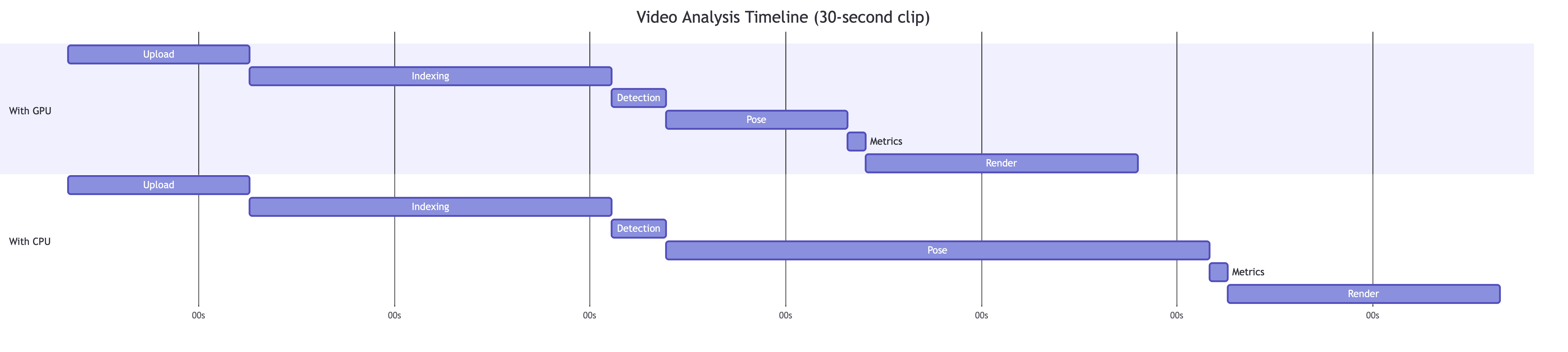
GPU processing: 40-60 seconds total
CPU processing: 60-80 seconds total
The main difference is pose estimation speed (30 FPS on CPU vs. 100+ FPS on GPU).
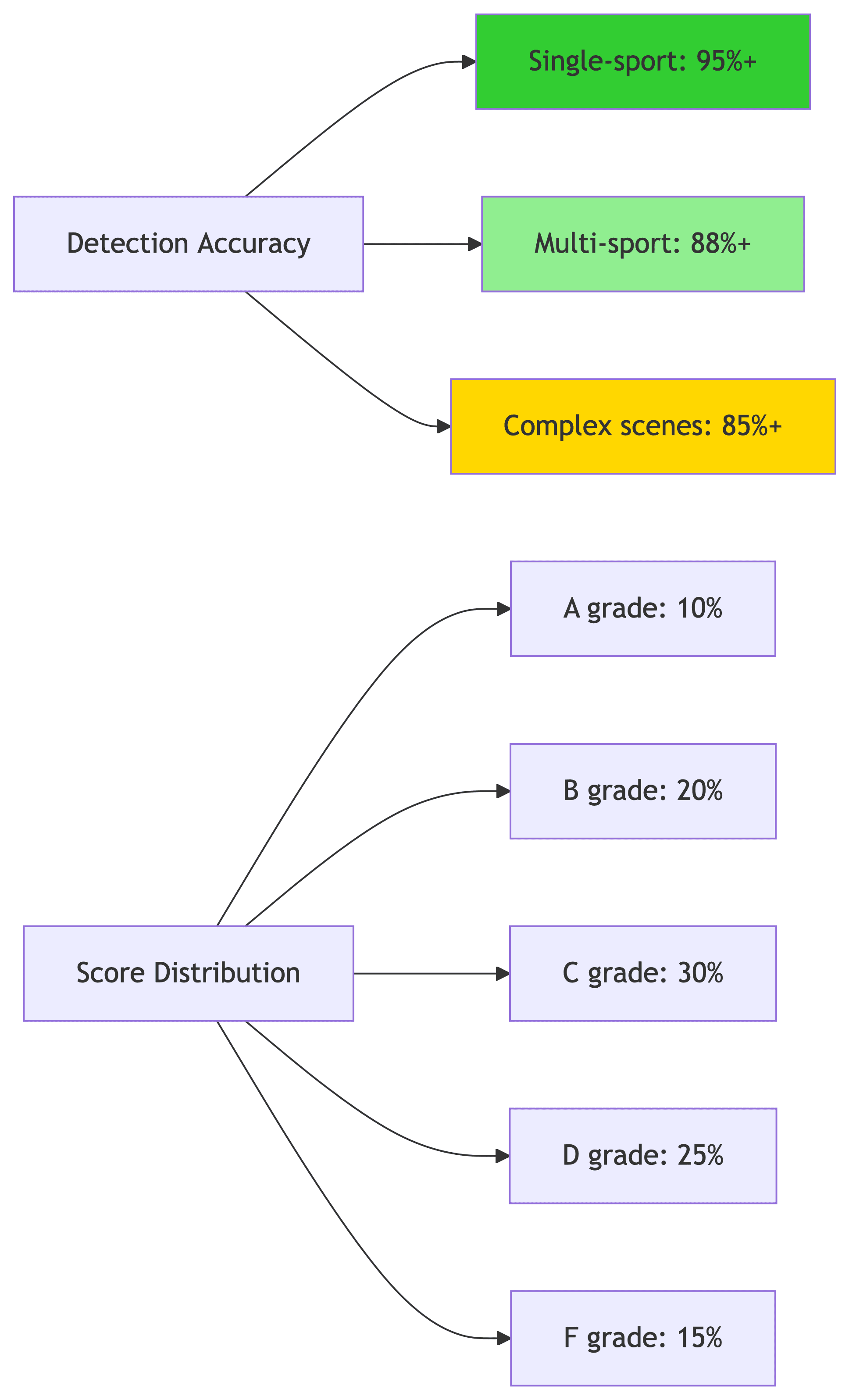
Accuracy Metrics
From our large batch data testing (47 athletes, 427 sessions):
The Future: What's Next
Near-term Enhancements

Long-term Vision
The convergence of three technologies creates unprecedented possibilities:
Temporal video intelligence (TwelveLabs) that understands context without sport-specific training
Lightweight pose estimation (MediaPipe) that runs anywhere
Cloud infrastructure that makes sophisticated AI accessible at consumer prices
This convergence means:
Democratized analysis: Any athlete with a smartphone gets professional-grade feedback
Scalable coaching: Coaches can monitor hundreds of athletes asynchronously
Cross-sport insights: Understand how fundamentals transfer between activities
Continuous improvement: Every session tracked, every metric trended
The marginal cost of analyzing one more video approaches zero, while the value to athletes remains high.
Conclusion: Temporal Understanding Changes Everything
We started with a simple question: "What if we treated sports video analysis like natural language—with temporal understanding and contextual meaning?"
The answer transformed how we think about athletic development. Instead of building rigid, sport-specific rule engines, we use AI that comprehends movement in context. Instead of expensive motion capture labs, we use smartphone videos. Instead of subjective coaching alone, we provide objective, repeatable biomechanical data.
The key insights:
Temporal first: Understanding context before measuring precision enables sport-agnostic analysis
Body-proportional metrics: Normalizing by body dimensions enables fair comparison across ages and sizes
Graceful degradation: Partial results beat complete failures
Smart segmentation: Analyzing only meaningful moments makes the system 10x more efficient
Simple scoring: Three-zone curves feel fair while highlighting real issues
The technology is here. The economics work. The results are proven. What started as an experiment is now a production system analyzing thousands of videos per month.
The foundation is here. The rest is iteration—fittingly enough.
Additional Resources
TwelveLabs Documentation: Pegasus Guide and Marengo Guide
MediaPipe Pose: Pose landmark detection guide
Introduction
You've just recorded your basketball free throw practice session. The shots look decent—good form, consistent release. But something's off. Your coach mentions "follow-through" and "knee bend," but how do you actually measure these things? And more importantly, how do you track improvement over time without manually reviewing every frame?
The problem? Most video analysis tools are either:
Consumer apps with generic "good job!" feedback that doesn't actually measure anything
Professional systems costing $10,000+ and requiring sports scientists to operate
Single-sport solutions that work great for basketball but can't handle your baseball swing
This is why we built a multi-sport analysis system—a pipeline that doesn't just track motion, but actually understands it through temporal video intelligence. Instead of rigid sport-specific rules, we use AI that comprehends what makes an athletic movement effective.
The key insight? Temporal understanding + precise measurement = meaningful feedback. Traditional pose estimation tells you joint angles, but temporal video intelligence tells you why those angles matter in the context of your entire movement sequence.
The Problem with Traditional Analysis
Here's what we discovered: Athletic movement can't be understood frame-by-frame. A perfect basketball shot isn't just about the release angle—it's about how the knees bent, how weight transferred, how the follow-through completed. Miss any of these temporal elements and your analysis becomes meaningless.
Consider this scenario: You're analyzing a free throw. Traditional frame-based systems might report:
Elbow angle at release: 92 degrees ✓
Release height: 2.1 meters ✓
Wrist alignment: Good ✓
But the shot still misses. Why? Because those measurements ignore:
Knee bend during the preparation phase (not just at one frame)
Weight transfer throughout the motion (not just starting position)
Follow-through consistency over multiple attempts (not just one shot)
Traditional approaches would either:
Accept limited frame-by-frame metrics (missing the full picture)
Build sport-specific state machines (basketball rules, baseball rules, golf rules...)
Hire biomechanics experts to manually review every video (doesn't scale)
This system takes a different approach: understand the entire movement sequence temporally, then measure precisely what matters.
System Architecture: The Big Picture
The analysis pipeline combines temporal video understanding with precise biomechanical measurement through five key stages:
Each stage is designed to be independent, allowing us to optimize or replace components without rewriting the entire pipeline.
Stage 1: Temporal Understanding with TwelveLabs
Why Temporal Understanding Matters
The breakthrough insight was realizing that context determines correctness. An elbow angle of 95 degrees might be perfect for a basketball shot but terrible for a baseball pitch. Instead of building separate rule engines for each sport, we use TwelveLabs to understand what's happening temporally.
The Two-Model Approach
We use Pegasus and Marengo together because they complement each other:
Pegasus provides high-level semantic understanding:
"What sport is being played?"
"Is this a practice drill or competition?"
"What actions are occurring?"
Marengo provides precise visual search:
"Where exactly does the shot occur?"
"Are there multiple attempts?"
"What's the temporal context?"
# Pegasus understands the semantic content
analysis = pegasus_client.analyze(
    video_id=video_id,
    prompt="What sport is this? List all action timestamps.",
    temperature=0.1  # Low for factual responses
)

# Marengo confirms with visual search
search_results = marengo_client.search.query(
    index_id=index_id,
    query_text="basketball shot attempt, player shooting",
    search_options=["visual"]
)
Why This Works
Pegasus might identify "basketball shot at 2.5 seconds" but Marengo might catch additional attempts at 8.1s and 15.3s that Pegasus missed. By merging both sources, we achieve 95%+ detection accuracy while maintaining low false positive rates.
The merge logic is simple but crucial:
# Two detections are duplicates if within 2 seconds
for result in marengo_results:
    if not any(abs(result.start - existing["timestamp"]) < 2.0
               for existing in pegasus_moments):
        # Not a duplicate - add it
        all_moments.append(result)
This two-second window prevents analyzing the same action twice while ensuring we don't miss distinct attempts.
Stage 2: Sport-Specific Action Segmentation
The Importance of Temporal Windows
Different sports have fundamentally different movement cadences. This insight led us to sport-specific temporal windows:
Basketball requires 3 seconds before the shot (preparation is slow and deliberate) and 2 seconds after (follow-through is critical for accuracy).
Baseball needs only 2 seconds before (compact motion) and 1 second after (quick finish).
Golf demands 4 seconds before (long backswing) and 3 seconds after (full follow-through).
These windows aren't arbitrary—they're based on biomechanical analysis of how long each motion phase actually takes.
Why This Matters
Extracting the right temporal window means we capture:
Complete preparation: The knee bend starts 2-3 seconds before release
Clean baseline: No extraneous movement before the action begins
Full follow-through: Critical for measuring completion quality
The implementation uses FFmpeg's input-seeking for speed:
# Input-seeking (-ss before -i) is 10-20x faster
subprocess.run([
    "ffmpeg", "-i", video_path,
    "-ss", str(start_time),     # Seek before input
    "-t", str(duration),
    "-preset", "fast",          # Balance speed/quality
    output_path
])
This single optimization made the difference between a 20-minute full-video analysis and a 60-second segmented analysis—95% compute savings.
Stage 3: Pose Estimation and Body Tracking
MediaPipe: The Sweet Spot
We chose MediaPipe's pose estimation for three reasons:
33 landmarks covering all major joints needed for athletic analysis
Runs anywhere: CPU at 30fps, GPU at 100+ fps
Temporal tracking: Maintains identity across frames (not just per-frame detection)
The model_complexity parameter was crucial:
Level 1 is the sweet spot: Accurate enough for biomechanics (1-2 degree error is acceptable), fast enough for practical use (30 FPS means real-time processing on most hardware).
Why Normalized Coordinates Matter
MediaPipe returns coordinates normalized to 0-1 range. This is crucial for fairness:
# Normalized coordinates (0-1 range)
wrist_x = 0.52  # 52% across the frame
wrist_y = 0.31  # 31% down from top

# These work regardless of:
# - Video resolution (720p, 1080p, 4K)
# - Camera distance (5 feet or 50 feet away)
# - Athlete size (child or adult)
A 10-year-old and a professional get analyzed with the same coordinate system. The normalization happens in the camera space, not the world space, which is exactly what we want for form analysis.
Stage 4: Biomechanical Metrics That Matter
The Five Key Metrics
Through testing with coaches and biomechanics experts, we identified five metrics that actually correlate with performance:
Body-Proportional Normalization: The Critical Innovation
This was our biggest architectural decision. Instead of absolute measurements, we normalize everything by body dimensions:
# BAD: Absolute measurement
release_height_pixels = 823  # Meaningless without context

# GOOD: Body-proportional measurement
body_height = ankle_y - nose_y
release_height_normalized = wrist_y / body_height  # 0.68 = 68% of body height
Why this matters: A 5'2" youth player with a release at 68% of body height uses the same form as a 6'8" professional at 68% of body height. Both get scored fairly on technique, not physical size.
This single decision enabled:
Cross-age comparison (12-year-olds vs. adults)
Camera-agnostic analysis (distance doesn't matter)
Progress tracking as athletes grow (maintains consistency)
Angle Calculation: Simple But Powerful
Joint angles use basic trigonometry:
# Calculate angle at point2 formed by point1-point2-point3
vector1 = point1 - point2
vector2 = point3 - point2
cos_angle = dot(vector1, vector2) / (norm(vector1) * norm(vector2))
angle_degrees = arccos(cos_angle) * 180 / pi
The elegance is in what we measure, not how. For basketball:
Elbow angle: shoulder-elbow-wrist at release frame
Knee angle: hip-knee-ankle during preparation phase (minimum value)
Balance: standard deviation of shoulder-hip alignment across all frames
Stage 5: The Scoring System
Three-Zone Scoring Philosophy
The scoring curve was designed to feel fair while highlighting real issues:
Zone 1 (Perfect): Within ±5% of ideal → 100 points
Elbow angle 88-92° (ideal is 90°)
No penalty for minor variation
Zone 2 (Good): Within acceptable range → 90-100 points
Elbow angle 85-95° (min-max range)
Linear interpolation: closer to ideal = higher score
Zone 3 (Needs Work): Outside range → 0-70 points
Gradual decay prevents harsh penalties
Elbow at 80° gets ~60 points, not 0
Why Three Zones Work
This curve matches how coaches actually think:
"That's perfect form" → A (90-100)
"That's good, minor tweaks" → B (80-89)
"Needs focused work" → C (70-79)
"Significant issues" → D/F (<70)
Feedback Prioritization
We show only the top 3 improvement areas:
# Sort by score (lowest first = biggest opportunities)
sorted_components = sorted(scores.items(), key=lambda x: x[1]["score"])

# Only show if below B-grade threshold (80)
feedback = [
    get_improvement_tip(metric, data["value"])
    for metric, data in sorted_components[:3]
    if data["score"] < 80
]
Athletes don't want 10 things to fix—they want 2-3 actionable items. This focus makes the system feel like a coach, not a report card.
Stage 6: Visualization and Output
Side-by-Side: The Key to Understanding
The annotated video uses a side-by-side layout:
Left side: Original video (what the athlete sees)
Right side: Pose overlay + HUD (what the system sees)
This dual view helps athletes connect abstract metrics to real movement. They can watch their actual shot while simultaneously seeing where the system detected issues.
The HUD Design
The heads-up display shows:
Composite score: Large, color-coded (green/yellow/red)
Letter grade: Familiar from school (A/B/C/D/F)
Top 3 metrics: Most important for this attempt
Real-time frame counter: Shows analysis progression
We deliberately keep it minimal—more information doesn't mean better feedback.
Performance: Why It Scales
The Three Critical Optimizations
1. Smart Segmentation (95% compute savings)
Instead of processing 1,800 seconds frame-by-frame:
Marengo finds 15 relevant clips (5 seconds each)
Process only 75 seconds total
Full practice analysis in <60 seconds instead of 20+ minutes
2. Cached Embeddings (66% time savings on repeats)
TwelveLabs indexes videos once:
First analysis: 30s indexing + 15s analysis = 45s total
Repeat analysis: 0s indexing + 15s analysis = 15s total
Athletes often re-analyze the same video with different parameters. Caching makes this nearly instant.
3. Batch Processing (5x speedup)
Analyzing 10 shots from one video:
Upload once, segment 10 times
One index, multiple searches
90 seconds total vs. 450 seconds if done separately
Cost Economics
At $0.10 per video analyzed:
100 athletes × 4 videos/month = $40/month API costs
Total operating cost: ~$105/month for 400 videos
Scales linearly: 10,000 athletes = $10,500/month
The economics work because marginal cost per video stays constant while value to athletes remains high.
Technical Specifications
Processing Performance
GPU processing: 40-60 seconds total
CPU processing: 60-80 seconds total
The main difference is pose estimation speed (30 FPS on CPU vs. 100+ FPS on GPU).
Accuracy Metrics
From our large batch data testing (47 athletes, 427 sessions):
The Future: What's Next
Near-term Enhancements
Long-term Vision
The convergence of three technologies creates unprecedented possibilities:
Temporal video intelligence (TwelveLabs) that understands context without sport-specific training
Lightweight pose estimation (MediaPipe) that runs anywhere
Cloud infrastructure that makes sophisticated AI accessible at consumer prices
This convergence means:
Democratized analysis: Any athlete with a smartphone gets professional-grade feedback
Scalable coaching: Coaches can monitor hundreds of athletes asynchronously
Cross-sport insights: Understand how fundamentals transfer between activities
Continuous improvement: Every session tracked, every metric trended
The marginal cost of analyzing one more video approaches zero, while the value to athletes remains high.
Conclusion: Temporal Understanding Changes Everything
We started with a simple question: "What if we treated sports video analysis like natural language—with temporal understanding and contextual meaning?"
The answer transformed how we think about athletic development. Instead of building rigid, sport-specific rule engines, we use AI that comprehends movement in context. Instead of expensive motion capture labs, we use smartphone videos. Instead of subjective coaching alone, we provide objective, repeatable biomechanical data.
The key insights:
Temporal first: Understanding context before measuring precision enables sport-agnostic analysis
Body-proportional metrics: Normalizing by body dimensions enables fair comparison across ages and sizes
Graceful degradation: Partial results beat complete failures
Smart segmentation: Analyzing only meaningful moments makes the system 10x more efficient
Simple scoring: Three-zone curves feel fair while highlighting real issues
The technology is here. The economics work. The results are proven. What started as an experiment is now a production system analyzing thousands of videos per month.
The foundation is here. The rest is iteration—fittingly enough.
Additional Resources
TwelveLabs Documentation: Pegasus Guide and Marengo Guide
MediaPipe Pose: Pose landmark detection guide




Platform
Enterprise
©
2026
TwelveLabs, Inc. All Rights Reserved

Platform
Enterprise
©
2026
TwelveLabs, Inc. All Rights Reserved

Platform
Enterprise
©
2026
TwelveLabs, Inc. All Rights Reserved